


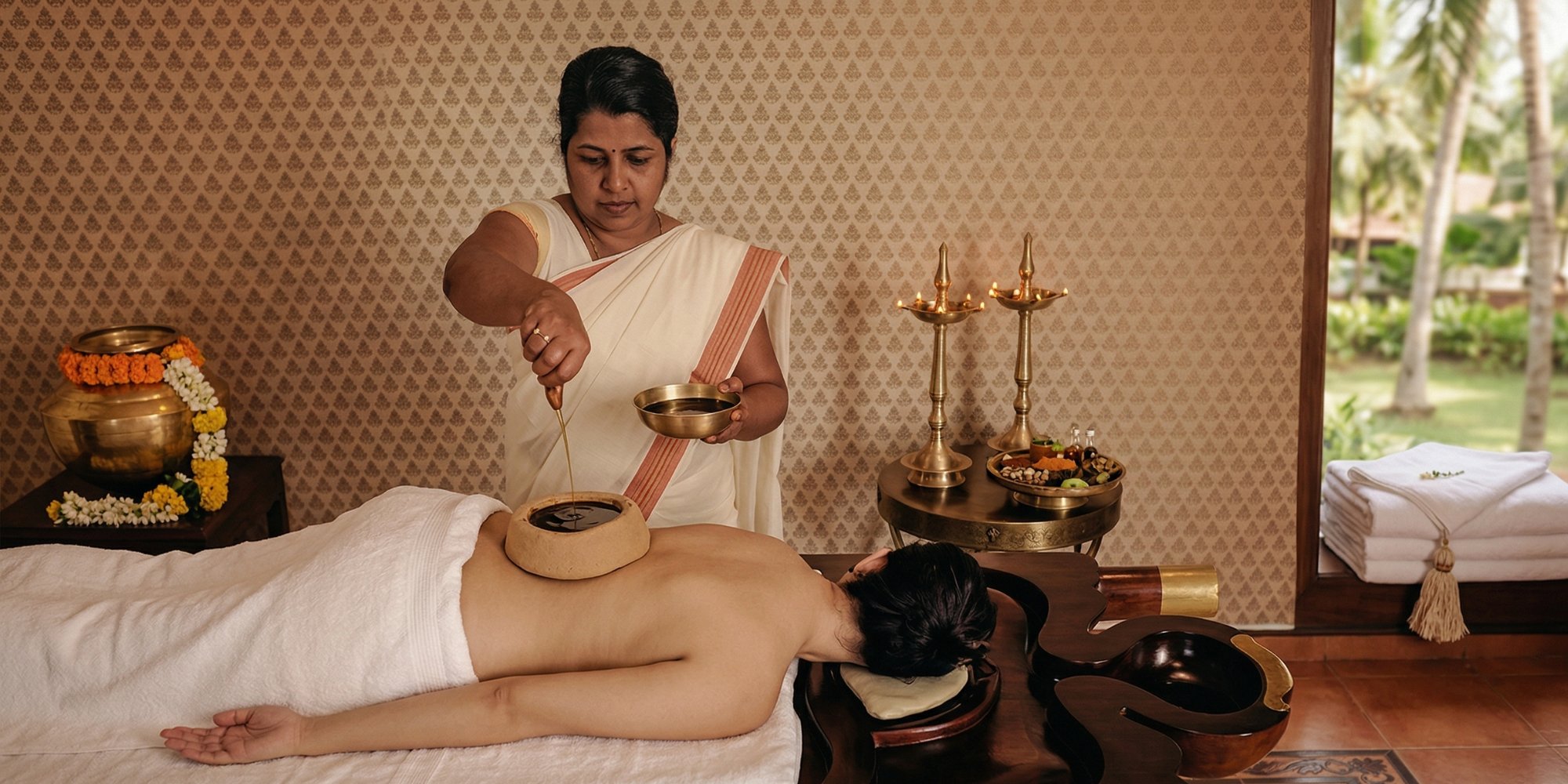
Kati Basti (Lumbar Oil Reservoir)
Overview: Kati Basti (Lumbar Oil Reservoir) Treatment
- ✓Doctor-Guided Diagnosis & Prakriti Assessment
- ✓Multi-Disciplinary ANP³ Integrated Care Plan
- ✓Targeted Root-Cause & Systemic Dosha Balancing
- ✓Supervised Panchakarma & Post-Therapy Care
The word Kati refers to the lower back (lumbar) region, and Basti translates to retaining something inside a compartment. Kati Basti is an intensive, localized form of Snigdha Sweda (oleation and sudation) where customized warm therapeutic oil is pooled over the lumbosacral region.
According to Ayurveda, the Kati (lower back) is a primary seat of Vata Dosha. When Vata becomes aggravated due to poor posture, trauma, or age, it causes drying of tissues, leading to stiffness, pain, and degeneration in the spine.
By holding warm, heavy, and unctuous (Snigdha) medicated oils over this region, Kati Basti directly counteracts the cold, dry, and rough qualities of morbid Vata. It rapidly reduces inflammation, nourishes dehydrated intervertebral discs, and restores spinal integrity without the need for invasive procedures.
Medically Reviewed By: Dr. Pasalapudi Visalaanjani, B.A.M.S, MD (Kayachikitsa)
Registration No: 1146/A/2016
Disclaimer: The information provided is for educational purposes and should not replace professional medical advice. Outcomes may vary.
Core Therapeutic Advantages
- Disc & Spine Nourishment: Deeply nourishes dehydrated intervertebral discs and strengthens the paravertebral muscles supporting the lumbar spine.
- Pain & Spasm Relief: Provides immediate relief from severe lower back pain, sciatica, and acute muscular spasms by pacifying localized Vata dosha.
- Improves Joint Mobility: Reduces stiffness in the lower back and pelvic region, greatly enhancing flexibility and range of motion.
- Nerve Decompression: The warmth and herbal properties help reduce inflammation around pinched nerves, specifically targeting sciatic nerve pain.
- Promotes Tissue Repair: Accelerates the healing of torn ligaments and tissues from sports injuries or chronic postural stress.
- Increases Circulation: Localized heat causes vasodilation, increasing oxygen and nutrient-rich blood flow to degenerate lumbar tissues.
Phased Treatment Procedure
Phase 1: Purvakarma
Clinical evaluation of the lumbar region to assess Vata derangement and muscular spasms. The specific medicated oil (e.g., Mahanarayana Taila, Ksheerabala, or Murivenna) is selected.
A gentle, warm oil massage is applied around the painful lower back area to loosen tight muscles and prepare the skin to absorb therapeutic heat.
Mild steam therapy is administered to the lumbar region to dilate the pores (Srotas) and further relax the para-spinal musculature.
Phase 2: Pradhana Karma
A leak-proof circular boundary (reservoir) is meticulously crafted over the lumbosacral region using a stiff dough made from black gram (Urad Dal) flour and water.
Warm, customized Ayurvedic medicated oil is gently poured into the dough reservoir. The therapeutic temperature is continuously maintained by replacing cooled oil with freshly warmed oil.
The oil is retained for 30 to 45 minutes. The continuous heat and active herbal compounds permeate deep into the muscle fascia, ligaments, and intervertebral discs.
Phase 3: Pashchatkarma
The oil is carefully scooped out, and the black gram dough ring is removed and discarded. The area is wiped clean.
A brief, soothing massage is performed using the residual oil to ensure complete absorption of the active medicinal principles into the tissues.
The patient rests for 15-30 minutes. Strict instructions are provided to avoid lifting heavy weights, bending forward, and exposure to cold drafts.

































