
What is vitiligo?
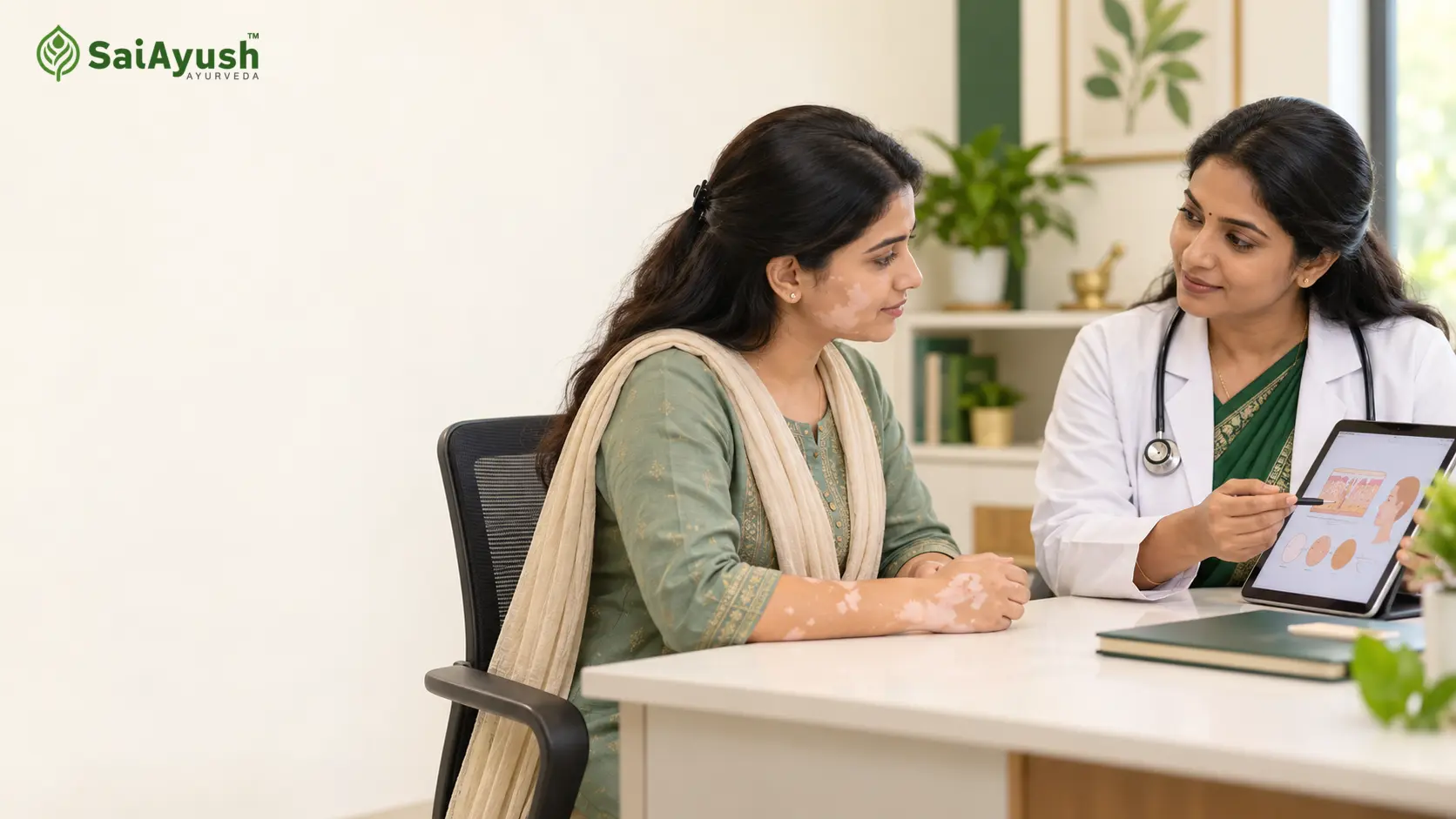
Vitiligo is a long-term skin condition in which smooth, pale or white patches appear because the cells that produce skin pigment (melanin) are lost or stop functioning. It can affect any area — commonly the face, hands, around the mouth and eyes, and skin folds — and patches may stay stable or slowly spread. It is believed to involve an autoimmune process, often alongside genetic and other factors. In Ayurveda, it is described as Shwitra (Kilasa), linked to imbalance affecting the skin and its pigment. You can read about our approach on our Ayurvedic vitiligo care page.
Is vitiligo contagious or dangerous?
This matters, so let's be clear: vitiligo is not contagious. You cannot catch it or pass it on by touch, sharing food, or any kind of contact. It is also not physically harmful or life-threatening, and it has nothing to do with leprosy — a common and hurtful misconception. Its main impact is cosmetic and emotional, and that emotional impact is real and deserves support.
Common myths about vitiligo
| Myth | Fact |
| "It's contagious" | False — it cannot spread from person to person |
| "It's caused by eating fish with milk" | A popular belief with no scientific basis |
| "It's the same as leprosy" | False — completely unrelated conditions |
| "Nothing can be done" | Not true — several approaches can help; results vary |
| "It always spreads everywhere" | Not necessarily — many cases stay limited or stable |
What causes vitiligo?
The exact cause isn't fully known, but contributing factors include:
- An autoimmune process (the body affecting its own pigment cells)
- A family history / genetic tendency
- Possible triggers such as significant stress, skin trauma or sunburn
- Links with some other autoimmune conditions (e.g. thyroid disorders)
In Ayurvedic understanding, Shwitra involves dosha imbalance affecting the skin's pigment, often connected with diet and lifestyle factors and impaired digestion — which is why management focuses on internal balance, not just the skin surface.
Can vitiligo be treated or cured?
Honest answer: there is no guaranteed cure, but vitiligo can often be managed, and some people see partial or significant repigmentation, especially with early and consistent treatment. Results depend on the type, extent, duration and location of the patches, and on individual response — areas like the face tend to respond better than hands and feet. The realistic goals are to help stabilise the patches, encourage repigmentation where possible, and support emotional wellbeing. Be cautious of anyone promising a total, permanent cure.
How does Ayurveda approach vitiligo?
Ayurvedic management of Shwitra is personalised to your constitution (Prakriti) and imbalance (Vikriti), and typically combines internal and external care:
- Shodhana (purification): supervised Panchakarma such as Virechana, used in selected cases to address the internal imbalance
- Herbal support: classical formulations traditionally used for skin and pigment (for example, preparations based on Bakuchi/Psoralea), prescribed and monitored by the doctor
- Diet & lifestyle: guidance on foods and habits that support skin health and digestion
- External applications & sun care as advised
- Emotional support: acknowledging and supporting confidence and mental wellbeing through the process
Because some herbs used for vitiligo (like Bakuchi) are potent and photosensitising, they should only be used under qualified supervision — not self-prescribed.
Living well with vitiligo
Vitiligo doesn't limit what you can do. Practical support includes gentle sun protection for pale patches, connecting with others who have the condition, and seeking help for the emotional side if it affects your confidence — that is a valid reason to seek care, not a weakness. Early assessment also gives treatment the best chance to help.
Noticing white patches, or living with vitiligo? Learn about our Ayurvedic vitiligo care, or book a consultation for a personalised assessment. Online and in-person consultations are available.
When to See a Doctor
Please seek prompt medical assessment if you notice:
- A rash with fever, or skin that is hot, red and spreading
- Blisters, peeling or open, weeping skin
- Swelling of the face, lips or throat
- Sudden patchy hair loss
- A mole or patch that changes shape or colour, or bleeds
These symptoms need medical evaluation first; Ayurvedic care is not a substitute for emergency treatment. At Sai Ayush Ayurveda Hospital, Hyderabad, our physician-supervised team will assess you and refer you onward where needed.
Frequently asked questions
Is vitiligo contagious? No. Vitiligo cannot be passed from person to person by any kind of contact. It is not an infection.
Can vitiligo be cured permanently? There is no guaranteed permanent cure, but it can often be managed, and some people achieve partial or significant repigmentation — especially with early, consistent treatment. Results vary between individuals.
Does vitiligo spread to the whole body? Not always. In many people patches stay limited or stable; in others they may slowly spread. The pattern varies, which is why assessment and monitoring help.
Is vitiligo related to leprosy? No. This is a harmful myth. Vitiligo is a pigment condition and is completely unrelated to leprosy.
Are Ayurvedic herbs for vitiligo safe to use on my own? No. Some, such as Bakuchi, are potent and can increase sun sensitivity. They should only be used under a qualified Ayurvedic doctor's supervision.
Talk to us
Sai Ayush Ayurveda Hospital — KPHB: +91 81423 28080 · Madinaguda: +91 84668 82266. Online & offline consultations available. Learn more on our Ayurvedic vitiligo care page.
Medical disclaimer
This article is for general information only and is not a substitute for professional medical advice, diagnosis or treatment. Ayurveda is offered here as a complementary system of care; vitiligo responses vary and no complete, permanent cure can be guaranteed. Some herbal treatments require supervision. Always consult a qualified physician and do not stop prescribed treatment without consulting your doctor.
Sources
- Mayo Clinic — Vitiligo: https://www.mayoclinic.org/diseases-conditions/vitiligo/symptoms-causes/syc-20355912
- NHS — Vitiligo: https://www.nhs.uk/conditions/vitiligo/
- Ministry of AYUSH, Government of India — Ayurvedic management of Shwitra/Kilasa

Medically Reviewed By
Dr. Pasalapudi Visalaanjani, B.A.M.S, MD (Kayachikitsa), Reg No: 1146/A/2016
Updated on October 27, 2026
This article is for educational purposes only and does not constitute medical advice. Please consult a qualified healthcare professional before beginning any treatment. If you are experiencing a medical emergency, contact your nearest hospital immediately.