

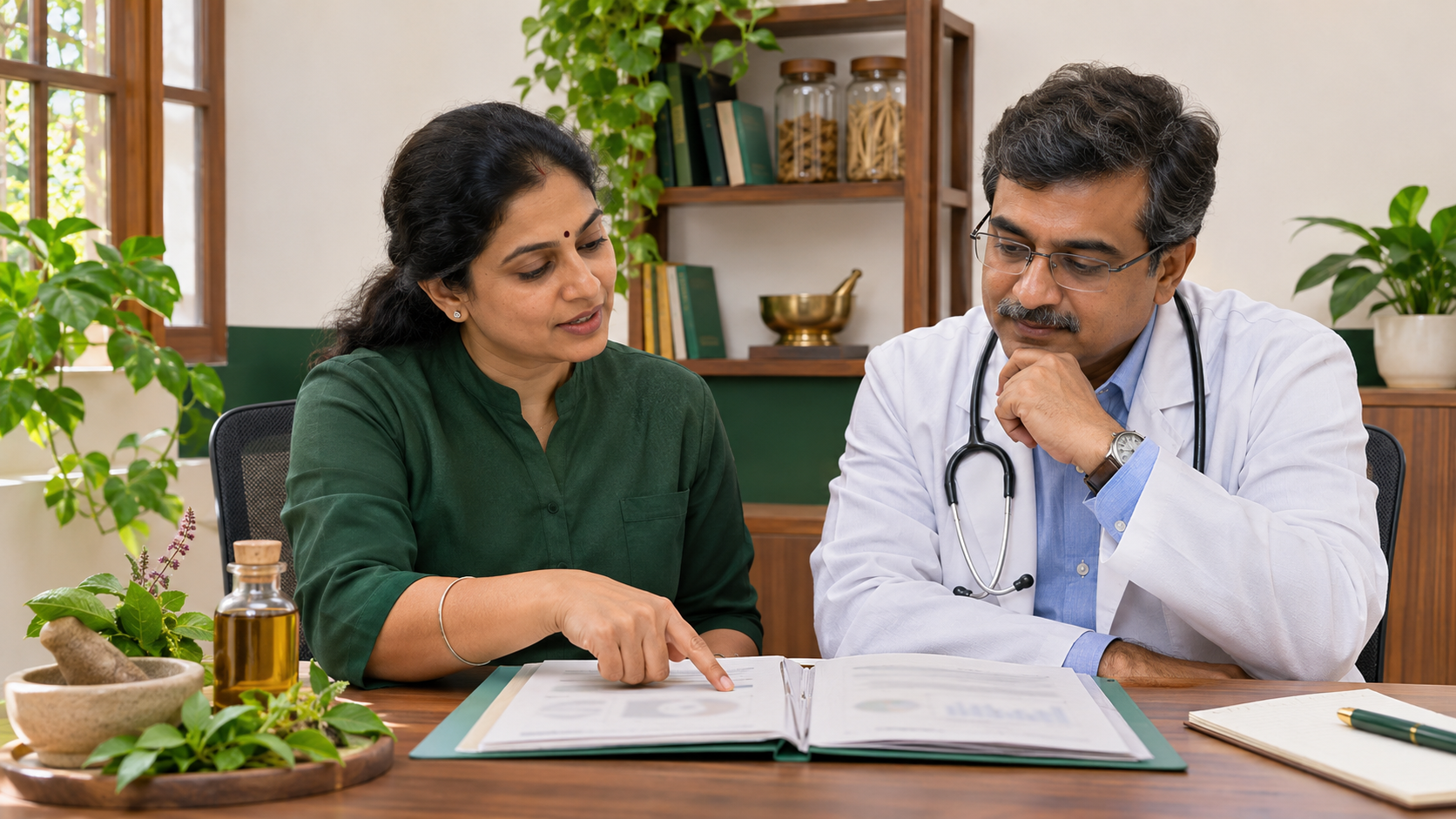
Two systems, one goal: the patient's wellbeing
Every system of medicine exists for the same reason — to help people get well and stay well. Modern medicine excels at emergencies, infections, surgery, imaging and precise diagnosis. Ayurveda, India's 3,000-year-old system, excels at understanding the whole person, correcting the root causes of chronic and lifestyle-driven problems, and supporting the body's own capacity to heal.
These strengths are complementary, not contradictory. A growing number of hospitals and health systems — in India and worldwide — now practise integrative medicine, where both work side by side. India has moved decisively in this direction: the Ministry of AYUSH and AIIMS have worked to establish integrative-medicine departments, and the World Health Organization opened its Global Centre for Traditional Medicine in India in 2022 to study and strengthen exactly this kind of evidence-based integration.
When can Ayurveda be a reasonable first-line option?
For many non-emergency, chronic or lifestyle-related conditions, it is quite reasonable to begin with an Ayurvedic approach — ideally after a proper medical diagnosis — because the focus is on correcting the underlying imbalance rather than only controlling symptoms. Common examples where people choose Ayurveda first include:
- Lifestyle and metabolic health — early or mild imbalances, stress, fatigue, and general wellness
- Digestive complaints — functional and recurring digestive problems
- Joint and muscle pain — mild to moderate, non-surgical
- Skin conditions — many chronic, non-urgent skin problems
- Sleep, stress and mental wellbeing — where calming therapies and lifestyle change help
- Prevention and rejuvenation — staying well, rather than waiting to fall ill
Importantly, "first-line" does not mean "instead of medical care." It means starting with a qualified Ayurvedic assessment for suitable problems, while keeping your doctor informed — and escalating to modern medicine whenever the condition requires it.
A note on serious and acute conditions: For medical emergencies (chest pain, stroke symptoms, severe injury, high fever, difficulty breathing) and serious acute disease, modern medicine should always come first. Ayurveda's role there is to support recovery afterwards — not to replace urgent treatment.
How Ayurveda can help speed recovery
One of Ayurveda's most valuable roles is in recovery and rehabilitation — helping patients regain strength, function and quality of life after the acute phase of an illness has been managed. Used as complementary care, it can:
- Support rehabilitation after stroke or paralysis, through therapies, physiotherapy and nourishing protocols — see our guide to an Ayurvedic inpatient program for stroke & paralysis recovery
- Aid post-surgical and post-illness convalescence — rebuilding appetite, energy and tissue strength (Rasayana)
- Help manage chronic pain and stiffness, reducing reliance on long-term painkillers where appropriate — see Ayurvedic management of arthritis and joint pain
- Ease treatment-related fatigue and stress, improving sleep, digestion and overall resilience
- Detoxify and rejuvenate through supervised Panchakarma — see when it's done as outpatient vs inpatient care
Because Ayurveda treats diet, lifestyle and the mind alongside the body, it often addresses the parts of recovery that busy acute care cannot — which is precisely why it works so well with modern medicine rather than against it.
What does the evidence say?
Research into integrative Ayurvedic care is still developing, but it is genuinely encouraging. A notable example is a double-blind, randomized, controlled pilot study (Furst et al., Journal of Clinical Rheumatology, 2011) that compared classical Ayurvedic treatment, methotrexate (a standard modern drug), and their combination in rheumatoid arthritis. All three groups improved, and the study found the treatments "approximately equivalent in efficacy, within the limits of a pilot study," with adverse events numerically fewest in the Ayurveda-only group. The authors called for larger trials — the responsible scientific position.
This is one study, not proof for every condition, and more high-quality research is needed. But it illustrates the real promise of combining systems thoughtfully: comparable benefit, potentially gentler on the patient, and stronger together.
A respectful note to our medical colleagues
To the allopathic doctors reading this: Ayurveda is not a competitor to your work, and this is not a call to send patients away from proven care. It is an invitation to collaborate. Our registered Ayurvedic physicians are glad to work alongside you — sharing clinical findings, respecting your prescriptions, and focusing on the areas where Ayurveda adds the most value: chronic-disease support, rehabilitation, prevention, lifestyle change and quality of life.
We never advise patients to stop prescribed medication without their treating doctor's involvement, and we refer promptly when a patient needs modern medical or surgical care. The goal is shared decision-making, with the patient — and their safety — at the centre.
A note to patients: you don't have to choose
If you are weighing Ayurveda against modern medicine, the good news is that you usually don't have to pick one. The safest and most effective path is often both, coordinated:
- Get a proper diagnosis so you know what you are treating.
- Keep both your doctors informed about every medicine and therapy you are using.
- Do not stop prescribed medicines on your own — any changes should be made with your treating doctor.
- Choose qualified, registered Ayurvedic practitioners.
Want to explore an integrative plan?
Learn about our Ayurvedic wellness treatments and Panchakarma center, or meet our team of registered Ayurvedic doctors. New to Ayurveda? Start with What is Ayurveda? Online and in-person consultations are available.
Frequently asked questions (FAQs)
Can I take Ayurvedic treatment and modern medicine together?
Often yes, under supervision. Many patients use Ayurveda alongside modern medicine. The key safety rule is to keep both doctors informed and never stop prescribed medicines without your treating doctor's advice, because some herbs can interact with medications.
Can Ayurveda be a first-line treatment?
For many suitable, non-emergency and chronic conditions, it can be a reasonable first choice — ideally after a proper diagnosis. For emergencies and serious acute illness, modern medicine should come first, with Ayurveda supporting recovery.
Does Ayurveda really help recovery?
Used as complementary care, Ayurveda can support rehabilitation (for example after stroke), post-surgical and post-illness convalescence, chronic pain, and treatment-related fatigue — improving strength, comfort and quality of life. Results vary between individuals.
Is it safe to combine the two systems?
It is generally safe when coordinated by qualified practitioners who know your full medication list. Risks arise mainly from unsupervised use or herb–drug interactions, which is why professional oversight matters.
Does modern science support Ayurveda?
Evidence is growing. Some studies — such as a 2011 pilot RCT in rheumatoid arthritis — found Ayurvedic treatment comparable to a standard drug with fewer side effects, though larger trials are still needed. Ayurveda is best viewed as evidence-informed complementary care.
Contact us
Sai Ayush Ayurveda Hospital — KPHB: +91 81423 28080 · Madinaguda: +91 84668 82266. Online and in-person consultations available. Explore our Ayurvedic wellness treatments and Panchakarma center.
References & further reading
- Furst DE, Venkatraman MM, et al. (2011). A double-blind, randomized, controlled pilot study comparing classic Ayurvedic medicine, methotrexate, and their combination in rheumatoid arthritis. J Clin Rheumatol, 17(4):185–192. https://pubmed.ncbi.nlm.nih.gov/21617554/
- Ayurveda–modern medicine interface (critical appraisal), J Ayurveda Integr Med (2010): https://www.ncbi.nlm.nih.gov/pmc/articles/PMC3087360/
- WHO — Traditional, Complementary and Integrative Medicine: https://www.who.int/health-topics/traditional-complementary-and-integrative-medicine
- NCCIH — Ayurvedic Medicine: In Depth: https://www.nccih.nih.gov/health/ayurvedic-medicine-in-depth
- Ministry of AYUSH, Government of India: https://www.ayush.gov.in/
Medical disclaimer
This article is for educational purposes only and is not medical advice. Ayurveda is described here as complementary and integrative care; it is not a substitute for emergency or necessary modern medical treatment. Do not stop or change any prescribed medication without consulting your treating doctor. Always consult qualified, registered practitioners, and keep all your doctors informed about every treatment you use. Results vary between individuals.
This article is for educational purposes only and does not constitute medical advice. Please consult a qualified healthcare professional before beginning any treatment. If you are experiencing a medical emergency, contact your nearest hospital immediately.