
What is Panchakarma, briefly?
Panchakarma is Ayurveda's five-step detoxification and rejuvenation process designed to remove accumulated toxins (ama) and restore balance to the body's doshas. Because it involves medicated procedures, specific diet, and a sequence of preparatory and main therapies, the setting in which you receive it — at home-visits or admitted in hospital — directly affects how safely and effectively it works. You can read the full process on our Panchakarma therapy page.
What is outpatient Panchakarma?
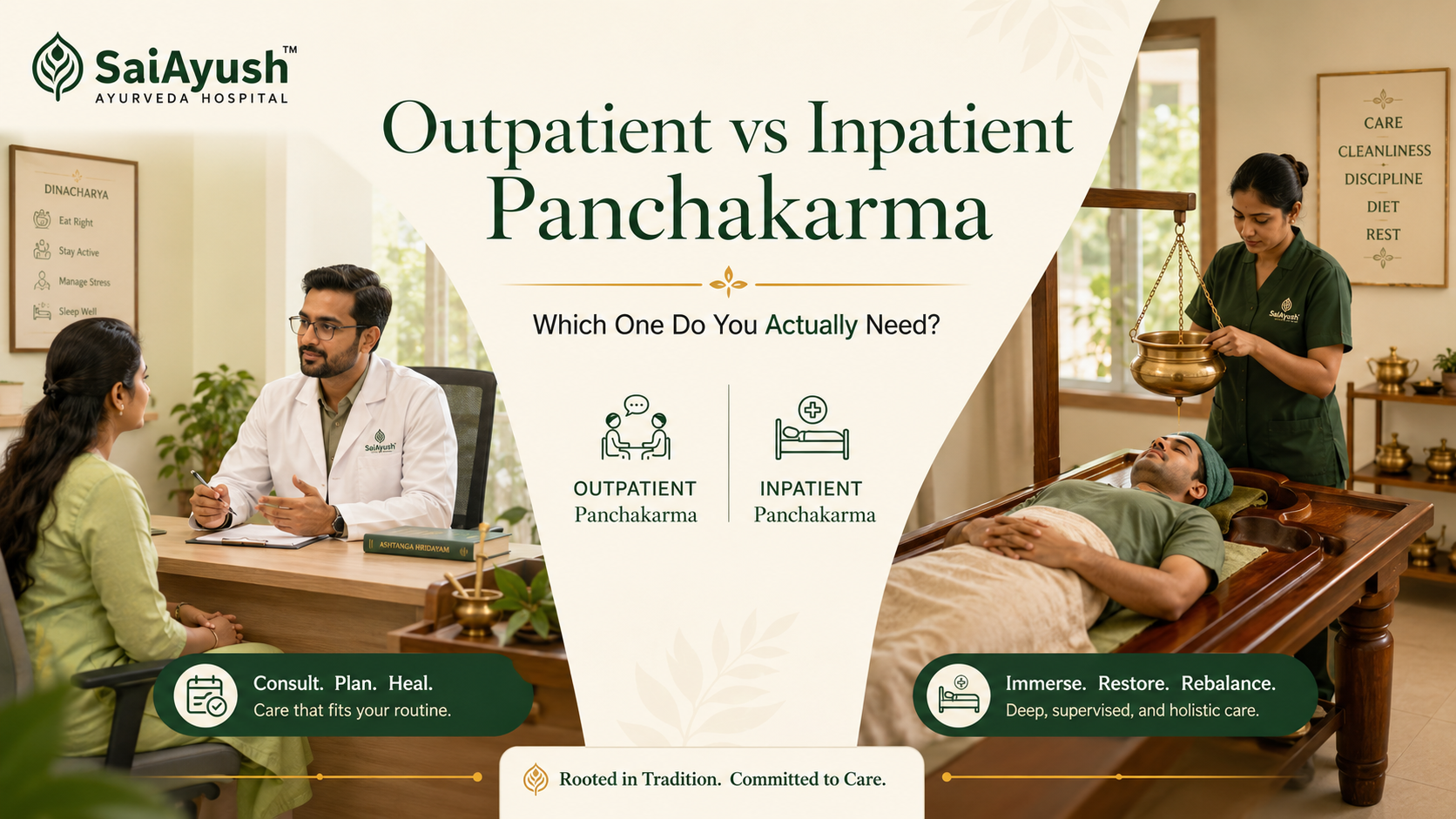
Outpatient (OPD) Panchakarma means you come to the hospital for your scheduled therapy, then go home the same day. You follow the prescribed diet and routine yourself between visits.
It generally suits people who:
- Have a mild imbalance or want a preventive, wellness-focused detox
- Are otherwise healthy and mobile
- Can strictly follow diet and rest instructions at home
- Have work or family commitments that prevent a residential stay
The trade-off is that the doctor cannot monitor you between sessions, and the effects of treatment can be diluted if home diet, rest or routine aren't maintained.
What is inpatient (residential) Panchakarma?
Inpatient or residential Panchakarma means you are admitted and stay at the hospital for the duration of the program. Therapies, diet, sleep and daily routine are all supervised by the clinical team.
It is usually recommended when:
- The condition is chronic, neurological or more advanced (for example, post-stroke care, paralysis, severe arthritis, or long-standing pain)
- Daily monitoring and adjustment of therapy are important
- A controlled diet and a calm, disturbance-free environment are needed for the body to respond
- Previous outpatient or home-based attempts haven't given lasting relief
In a residential program, the full sequence — preparation (Purvakarma), the main procedures, and recovery (Paschatkarma) — can be carried out correctly and consistently, which is difficult to replicate at home.
Outpatient vs inpatient Panchakarma: a quick comparison
| FactorI | Outpatient Patient Panchakarma | Inpatient Panchakarma (Residential) |
| Where you stay | Go home daily after each session | Admitted at the hospital |
| Supervision | During sessions only | Continuous, throughout the stay |
| Best for | Mild concerns, prevention, wellness | Chronic, neurological or severe conditions |
| Diet & routine | Self-managed at home | Controlled and supervised |
| Typical duration | Spread over several visits | Continuous program (often1–3 weeks) |
| Environment | Everyday home setting | Calm, rest-focused, disturbance-free |
| Consistency of results | Depends on home compliance | More consistent under supervision |
| Duration and suitability vary by individual — your doctor will advise after assessment. |
How do I know which one I need?
The honest answer is that this is a medical decision, not a self-assessment. As a general guide: if you are largely healthy and want a preventive reset, outpatient may be enough. If your condition is chronic, affects mobility or the nervous system, or hasn't improved with previous treatment, a residential program is usually the more effective choice. At Sai Ayush Ayurveda Hospital, the doctor assesses your constitution (Prakriti) and current imbalance (Vikriti) before recommending the right format under our integrated ANP³ Method™ (Ayurveda, Naturopathy and Physiotherapy), backed by a 33+ year legacy and DMHO certification.
Not sure which is right for you? Speak to our team about a pre-admission assessment, or explore our residential Panchakarma and wellness packages. For specific conditions, see our pain management and neurological care pages.
Why does the setting matter so much for results?
Panchakarma is not only the therapy on the table — it's the diet, the rest, the timing of meals, and avoiding disturbances while the body detoxifies. In a residential setting, all of these are managed for you, so the treatment works as a complete system. At home, even with good intentions, an irregular meal, poor sleep or a stressful day can reduce the benefit. This is why doctors often recommend admission for conditions that need the body to fully focus on healing.
What to expect if you're admitted
A residential stay typically includes a daily therapy schedule, a personalised Ayurvedic diet, rest periods, and yoga or relaxation practices, with regular review by your doctor. Family can usually visit, and both online and in-person consultations are available before you decide. For practical details — duration, what to bring, daily routine — ask our team during your consultation. Residential admission is at our KPHB hospital; outpatient consultations are also available at our Madinaguda clinic.
Frequently asked questions
Is inpatient Panchakarma better than outpatient? Neither is universally "better" — they suit different needs. Outpatient works well for mild or preventive care, while inpatient is usually more effective for chronic, neurological or severe conditions because of the continuous supervision and controlled environment.
How long does inpatient Panchakarma take? It varies by condition and goal, but residential programs commonly run from about one to three weeks. Your doctor will recommend a duration after assessment.
Can I do Panchakarma at home? Some simple therapies can be done as outpatient care, but full Panchakarma involves medicated procedures and a controlled diet that are safest under supervision. Authentic, complete Panchakarma is best done in a hospital setting.
Will my family be able to stay or visit during admission? Visiting arrangements are usually available at our KPHB hospital, where residential programs run. Please confirm the current policy when you book.
Do I need a consultation before admission? Yes. A consultation lets the doctor assess whether outpatient or inpatient care suits your condition and design a personalised plan. Online and in-person consultations are both available.
Talk to our admissions team
Inpatient admission and residential Panchakarma are at our KPHB hospital — call +91 81423 28080. Our Madinaguda location is a consultation clinic only (outpatient consultations: +91 84668 82266). Ask about a pre-admission assessment for residential Panchakarma. Online & offline consultations available. Book a consultation.
Medical disclaimer
This article is for general information only and is not a substitute for professional medical advice, diagnosis or treatment. The choice between outpatient and inpatient Panchakarma should be made by a qualified Ayurvedic physician after assessment. Ayurveda is offered here as a complementary system of care; results vary between individuals. Do not stop any prescribed medication without consulting your doctor.
Sources (verify before publishing)
- Ministry of AYUSH, Government of India — on Panchakarma and Ayurvedic standards
- World Health Organization — Traditional, Complementary and Integrative Medicine
Medically Reviewed By
Dr. Pasalapudi Visalaanjani, B.A.M.S, MD (Kayachikitsa), Reg No: 1146/A/2016
Updated on september 10, 2026