

Taila Dhara Benefits, Procedure, Safety and Differences
Taila Dhara is an Ayurvedic external procedure involving a controlled stream of physician-selected oil over the forehead, body or a particular area. The application site, oil, temperature and duration vary according to the prescribed form of Dhara and the individual’s clinical assessment.
Traditionally described Taila Dhara benefits may include relaxation, comfort and support for selected concerns. However, scientific evidence is limited, and Taila Dhara should not be presented as a cure or replacement for necessary medical care.
What does Taila Dhara mean?
The word taila generally refers to oil, while dhara describes a continuous or controlled stream.
Taila Dhara is therefore a broad descriptive term rather than one identical treatment protocol. The oil may be directed over:
- The forehead
- The whole body
- A selected joint or body region
- Another area prescribed by the Ayurveda physician
The name of the procedure may change according to the application site, liquid used and technique.
Is Taila Dhara the same as Shirodhara?
Not always.
Shirodhara specifically refers to a controlled stream applied over the forehead or head region. Oil may be used, but a physician may select another appropriate liquid preparation in some protocols.
“Taila Dhara” describes the use of oil and may refer to a forehead application, whole-body stream or regional application. The intended procedure should therefore be confirmed rather than identified only by the general name.
Taila Dhara, Shirodhara, Pizhichil and Dhanyamla Dhara
| Feature | Taila Dhara | Shirodhara | Pizhichil | Dhanyamla Dhara |
| Basic meaning | Controlled application of an oil stream | Controlled stream over the forehead or head area | Warm oil is streamed over the body, commonly with prescribed strokes | A fermented or herbal liquid preparation is poured over the body or selected area |
| Usual medium | Physician-selected oil | Oil or another prescribed liquid | Usually medicated oil | Dhanyamla or another prescribed fermented preparation |
| Application area | Forehead, body or selected region | Forehead or head region | Commonly the body | Body or selected region |
| Main difference | Broad oil-stream description | Defined by application over the head region | Whole-body oil-stream procedure with a distinct protocol | Defined primarily by its prescribed liquid |
| Selection | Individual clinical assessment | Individual clinical assessment | Individual clinical assessment | Individual clinical assessment |
These procedures are not interchangeable. The formulation, temperature, duration and technique should be prescribed separately.
Traditionally described Taila Dhara benefits
Traditional Ayurvedic practice may consider Taila Dhara as part of an individualised plan to support:
- Relaxation and rest
- Comfort associated with stiffness
- External oleation of the skin
- Preparation or follow-up within a broader Ayurveda programme
- Support for selected Vata-related assessments
- A structured, calming treatment routine
These are traditional uses, not guarantees of a medical outcome.
Taila Dhara should not be advertised as proven to:
- Cure insomnia, anxiety or depression
- Reverse paralysis or neurological disease
- Repair nerves or joints
- Remove toxins from the body
- Prevent ageing
- Strengthen immunity
- Treat every pain condition
- Replace prescribed medicines
What does current scientific evidence show?
Research directly evaluating the broad procedure called Taila Dhara is limited.
Some small studies and case series have examined Shirodhara for sleep, stress or related measures. These studies generally involve small participant numbers, different liquids, varying procedures and limited controls.
Their results cannot establish that:
- All forms of Taila Dhara have the same effect
- Taila Dhara treats a diagnosed disease
- A short-term relaxation response produces lasting medical improvement
- The treatment is suitable for every patient
More rigorous and standardised clinical studies are required.
How is Taila Dhara performed?
The exact procedure depends on the prescribed application. A supervised session may include the following stages.
1. Clinical assessment
The Ayurveda physician reviews:
- The person’s symptoms and health goals
- Medical history
- Current medicines
- Skin sensitivity and allergies
- Recent injuries or surgery
- Pregnancy status
- Blood-pressure concerns
- Heat sensitivity or reduced sensation
- Suitability for an oil-based external procedure
A therapist should not independently select the oil or prescribe the procedure.
2. Selection of the procedure
The physician determines:
- Application area
- Type of oil
- Temperature
- Flow rate
- Duration
- Patient position
- Whether preparatory or follow-up care is needed
These details should not be copied from a standard online protocol.
3. Preparation
The patient is positioned safely and modestly in a clean clinical treatment room. The treatment area is inspected for wounds, rashes, infections or other contraindications.
The oil is warmed only when prescribed, and its temperature must be checked before and during application.
4. Controlled oil stream
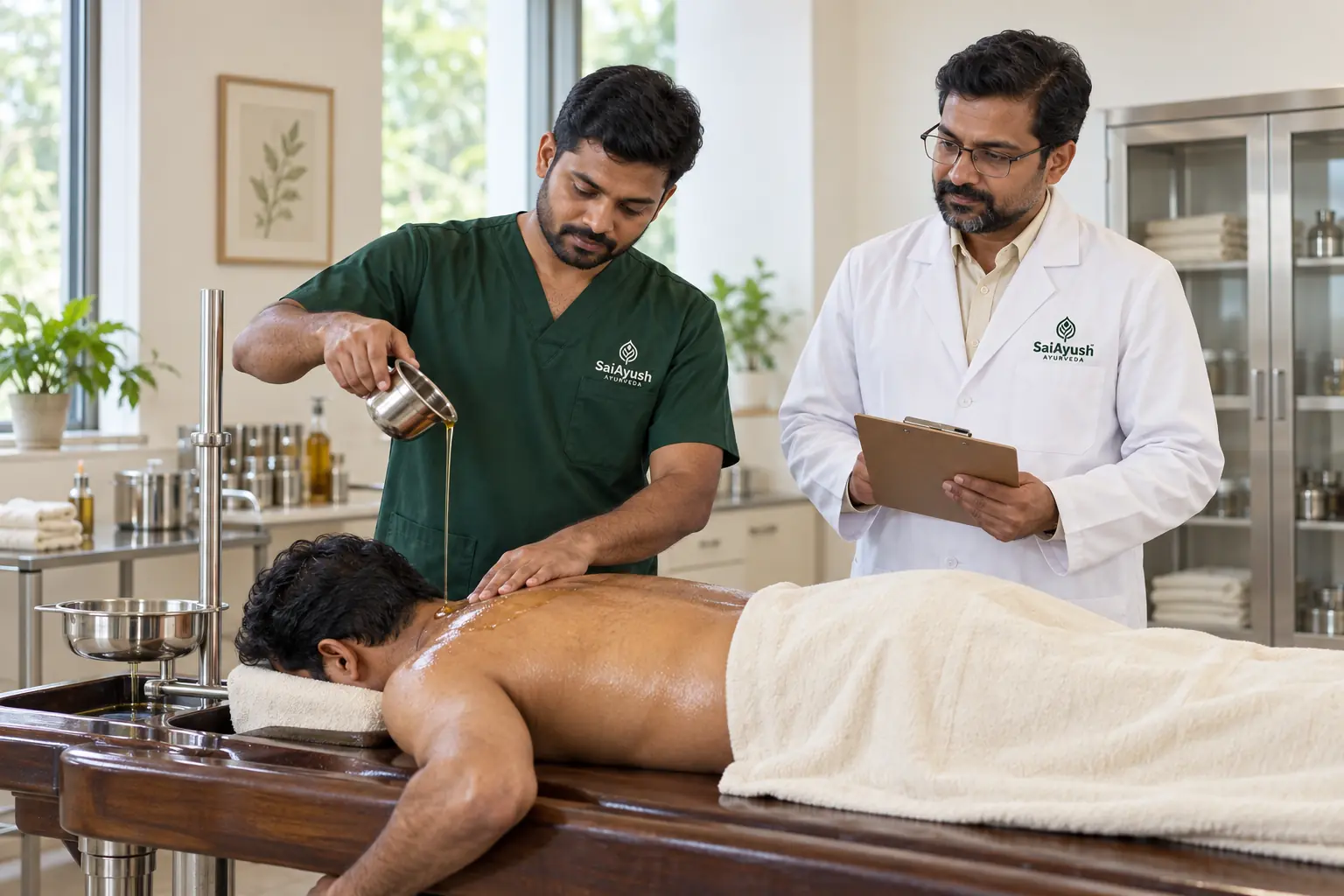
A trained therapist applies the oil in a controlled stream over the prescribed area.
The patient should immediately report:
- Excessive heat
- Burning or itching
- Dizziness
- Headache
- Nausea
- Breathing difficulty
- Unusual discomfort
5. Completion and observation
After the prescribed duration, excess oil is removed carefully. The patient may be advised to rest briefly while the therapist or physician checks for dizziness, skin irritation or another unexpected response.
How long does a session take?
There is no single duration suitable for everyone.
The appointment may include preparation, the main procedure, cleaning and post-procedure rest. The duration depends on:
- Type of Dhara
- Application area
- Patient’s age and health
- Oil and temperature selected
- Treatment response
- Physician’s plan
Avoid publishing a guaranteed number of sessions or fixed course without confirming Sai Ayush’s approved protocol.
Possible side effects and risks
Taila Dhara is an external procedure, but it is not risk-free. Possible unwanted effects include:
- Skin irritation
- Allergic contact dermatitis
- Burning from excessive oil temperature
- Headache or discomfort
- Dizziness or light-headedness
- Nausea
- Slipping or falling because of oil on the floor
- Aggravation of an existing skin condition
- Discomfort from remaining in one position
Substances placed on the skin can cause irritant or allergic contact dermatitis. Symptoms may include itching, redness, swelling or a rash. The American Academy of Dermatology provides general information about contact reactions.
Who may not be suitable?
Taila Dhara may be postponed, modified or avoided in people with:
- Fever or an acute infection
- Open wounds or active skin infection
- Known allergy to the proposed oil
- Severe or unexplained headache
- Recent head injury
- Active scalp inflammation
- Uncontrolled medical illness
- Dizziness, fainting or balance problems
- Reduced heat sensation or significant neuropathy
- A condition that makes safe positioning difficult
- Recent surgery affecting the treatment area
Pregnant or breastfeeding patients, older adults and people taking several medicines should provide their full medical history before the procedure.
Suitability depends on the procedure being considered. Forehead Taila Dhara and whole-body oil streaming do not have identical precautions.
What if the oil feels too hot?
Tell the therapist immediately and stop the procedure.
A hot-oil or liquid burn should be cooled promptly under cool or lukewarm running water. Do not apply more oil to a burn. The NHS burn guidance recommends cooling a burn under running water and obtaining appropriate medical help depending on its severity.
A properly supervised procedure should include temperature checks and continuous observation.
Preparation before the appointment
Patients may be advised to:
- Provide a complete medication and allergy history
- Mention skin reactions to oils, fragrances or herbs
- Report recent illness, surgery or injury
- Avoid arriving immediately after a heavy meal
- Remove jewellery near the application area
- Wear suitable clothing
- Arrange assistance if they commonly experience dizziness
Follow the individual instructions given by the treating physician rather than general advice found online.
Aftercare
Depending on the procedure, the physician may advise the patient to:
- Stand up slowly after resting
- Avoid slippery surfaces
- Keep the treated area clean
- Follow instructions about bathing
- Report persistent redness, burning or itching
- Avoid applying additional products without advice
Seek medical help if there is a significant burn, facial swelling, breathing difficulty, widespread rash, fainting or rapidly worsening symptoms.
Can Taila Dhara be performed at home?
A simple personal oil application is not the same as a clinical Dhara procedure.
Attempting continuous warm-oil pouring at home can create risks involving:
- Incorrect temperature
- Falls caused by spilled oil
- Skin reactions
- Unsuitable ingredients
- Poor positioning
- Delayed medical assessment
A clinical Taila Dhara procedure should be selected by an Ayurveda physician and performed by a trained therapist using an appropriate safety protocol.
What to expect at Sai Ayush
At Sai Ayush Ayurveda Hospital, an Ayurveda physician should first assess the patient and decide whether Taila Dhara or another procedure is appropriate.
The physician determines the procedure, oil, treatment area and duration. A trained therapist then performs the prescribed procedure under the clinical plan.
Patients may meet the Sai Ayush Ayurveda doctors for an individual assessment. Consultation does not guarantee that Taila Dhara will be advised.
Frequently asked questions
What is the main difference between Taila Dhara and Shirodhara?
Taila Dhara describes an oil-stream application. Shirodhara is defined primarily by the stream being applied over the forehead or head region.
Is Taila Dhara a Panchakarma procedure?
It may be used as an external supportive procedure within an Ayurveda or Panchakarma plan. It is not itself one of the five primary cleansing procedures traditionally associated with Panchakarma.
Does Taila Dhara cure stress or insomnia?
There is insufficient evidence to claim that it cures either condition. Persistent sleep or mental-health symptoms require appropriate clinical evaluation.
Is the same oil used for everyone?
No. If treatment is suitable, the oil should be selected according to the physician’s assessment and the intended procedure.
How many sessions are required?
There is no universal number. Frequency and duration depend on the procedure, assessment and patient response.
Can prescribed medicines be stopped during treatment?
No. Do not stop or change any prescribed medicine unless the prescribing clinician advises you to do so.
Key takeaway
Taila Dhara is a broad Ayurvedic oil-stream procedure whose application area, oil, temperature and duration must be selected individually.
Traditionally described Taila Dhara benefits should be communicated cautiously because current scientific evidence is limited. The procedure should remain physician-selected, therapist-delivered and supported by appropriate safety precautions.
Medical disclaimer: This article provides general educational information and does not diagnose or treat any condition. Suitability and outcomes vary. Consult a qualified healthcare professional for individual advice.
Medically Reviewed By
Dr. Pasalapudi Visalaanjani, B.A.M.S, MD (Kayachikitsa), Reg No: 1146/A/2016
Updated on september 10, 2026