
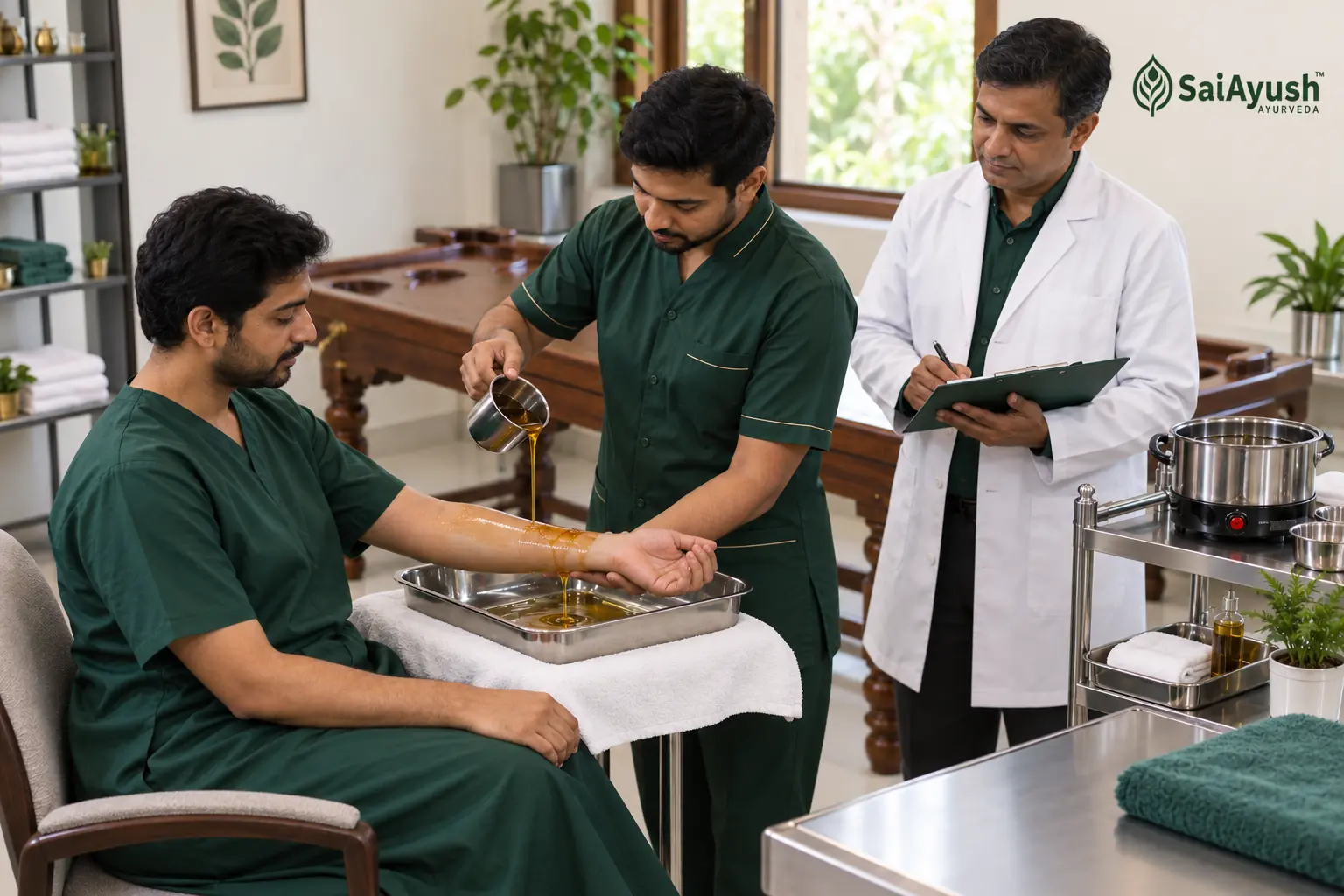
Kaya Sekam is an external Ayurvedic procedure in which a physician-selected warm medicinal liquid is poured in controlled streams over the body or a prescribed body area. Depending on the treatment plan, the liquid may include medicated oil, a herbal decoction or another suitable preparation.
Kaya Sekam is frequently associated with Pizhichil, a Kerala Ayurvedic therapy that generally uses warm medicated oil poured continuously over the body while trained therapists perform controlled strokes.
The terms are sometimes used interchangeably. However, terminology and technique can vary between Ayurvedic traditions. A patient should therefore ask the treating physician what liquid will be used, which body area will be treated and what the intended clinical purpose is.
What does Kaya Sekam mean?
“Kaya” refers to the body, while “Seka” or “Sekam” refers to pouring or sprinkling a liquid in a controlled manner.
Kaya Sekam can therefore be understood as the controlled pouring of a prescribed liquid over the body. It is generally classified as an external Ayurvedic procedure and is associated with Parisheka Sweda, in which warm liquid is used as part of a physician-directed fomentation approach.
The procedure is not simply an oil bath or relaxation massage. The medicine, temperature, duration and treated area should be selected individually after clinical assessment.
Is Kaya Sekam the same as Pizhichil?
Kaya Sekam is a broader descriptive term for controlled liquid pouring over the body. Pizhichil is commonly used for the Kerala practice in which warm medicated oil is streamed over the body, often alongside gentle, coordinated massage strokes.
Some practitioners use Kaya Sekam and Pizhichil as synonyms. Other traditions describe Pizhichil as an oil-based form or modified application of Kaya Sekam. The exact terminology should therefore be confirmed with the treating physician.
The practical differences may include:
| Feature | Kaya Sekam | Pizhichil | Abhyanga |
| Basic method | A prescribed warm liquid is poured in controlled streams over the body or selected area. | Warm medicated oil is streamed continuously while controlled massage strokes are performed. | Medicated oil is applied directly using prescribed massage strokes. |
| Possible medium | Oil, herbal decoction or another physician-selected liquid. | Usually medicated oil. | Usually medicated oil. |
| Coverage | Whole body or a prescribed area. | Commonly performed as a whole-body procedure. | Whole-body or localised oil application. |
| Liquid flow | Controlled pouring or streaming technique. | Continuous or repeated rhythmic oil stream. | Continuous pouring is not required. |
| Selection | Based on the condition, intended purpose and patient tolerance. | Based on physician assessment and suitability for an oil-based procedure. | Based on the condition and prescribed oil. |
| Important note | The exact liquid and protocol should be confirmed with the physician. | It should not be presented as a guaranteed treatment for any disease. | It is a clinical oil-application procedure, not merely a spa massage. |
Learn more about Pizhichil therapy and Abhyanga.
Why may an Ayurveda physician consider Kaya Sekam?
In traditional Ayurvedic practice, Kaya Sekam may be considered as part of an individualised programme when controlled external application of a warm liquid is clinically appropriate.
Traditional treatment objectives may include:
- Providing external oleation when medicated oil is selected
- Applying controlled warmth to the prescribed body area
- Supporting temporary relief from stiffness or physical discomfort
- Preparing for or complementing another physician-directed procedure
- Supporting general relaxation and physical comfort
These are traditional treatment objectives. They do not establish that Kaya Sekam cures arthritis, paralysis, neurological disorders or other medical conditions.
The current clinical evidence is insufficient to guarantee specific outcomes from Kaya Sekam as a stand-alone procedure.
How is Kaya Sekam performed?
The exact hospital protocol varies according to the liquid selected and the patient’s clinical requirements.
1. Clinical assessment
The Ayurveda physician reviews:
- The patient’s main symptoms and diagnosis
- Skin condition and sensitivity
- Blood pressure and general health
- Heat tolerance
- Current medicines
- Previous surgery or injuries
- Pregnancy status
- Risk of falls, dizziness or dehydration
The doctor determines whether the procedure is suitable and whether whole-body or localised application is appropriate.
2. Selection of the medicinal liquid
The liquid should be selected by the physician. Depending on the intended purpose, it may include medicated oil, herbal decoction or another suitable preparation.
Patients should be informed about the material being used, particularly if they have allergies or sensitive skin.
3. Temperature check
The liquid is warmed and its temperature is checked before and during the procedure.
The temperature should remain comfortable and should never cause burning, excessive sweating, dizziness or distress. It may need to be adjusted during the session according to the patient’s response.
4. Controlled pouring
The patient is positioned on a suitable treatment table with proper privacy and draping. Trained therapists pour the prescribed liquid in controlled streams over the selected area.
When Pizhichil-style oil application is prescribed, gentle coordinated strokes may be performed while the oil is being streamed.
5. Monitoring
The therapist observes the patient’s comfort, skin response, temperature tolerance and general condition.
The procedure must be stopped if the patient develops pain, excessive heat, weakness, nausea, breathing difficulty, dizziness or another unexpected reaction.
6. Post-procedure care
Excess liquid is removed carefully. The patient may be advised to rest before standing, particularly when warmth or oil creates a risk of dizziness or slipping.
Bathing, food, activity and follow-up instructions should be based on the physician’s advice.
Is Kaya Sekam suitable for pain or stiffness?
People with pain, muscle tightness or joint stiffness may be interested in Kaya Sekam. However, these symptoms can result from several conditions, including injury, infection, inflammatory disease, nerve compression or degenerative changes.
A proper diagnosis is therefore necessary before therapy is selected.
Kaya Sekam should not delay medical investigation of:
- Severe or worsening pain
- Recent trauma or suspected fracture
- Progressive weakness
- New numbness or loss of sensation
- Loss of bladder or bowel control
- Fever with joint or back pain
- Sudden difficulty walking
These symptoms may require urgent medical assessment.
Who may need to avoid Kaya Sekam?
Kaya Sekam may be unsuitable or require additional medical clearance for people with:
- Fever or acute infection
- Open wounds, burns or active skin infection
- Reduced heat sensation or peripheral neuropathy
- Uncontrolled blood pressure
- Severe cardiovascular instability
- Acute inflammation or recent injury
- Known allergy to the prescribed ingredients
- Severe weakness, dehydration or dizziness
- Recent surgery
- Pregnancy
- Difficulty safely transferring onto the therapy table
This is not a complete contraindication list. Suitability must be determined individually.
Can Kaya Sekam be performed at home?
Whole-body Kaya Sekam should not be attempted at home using heated oil or herbal liquids.
Incorrect temperature can cause burns. Spilled oil creates a significant slipping risk, and a person may become dizzy after exposure to warmth. Hygiene, temperature control, patient positioning and monitoring are important parts of safe administration.
Home treatment should never be based only on an online recipe or video.
Kaya Sekam at Sai Ayush Ayurveda Hospital
At Sai Ayush Ayurveda Hospital, Panchakarma and external therapies are considered only after an assessment by a qualified Ayurveda physician.
The physician determines whether Pizhichil, Kaya Sekam, Abhyanga or another procedure is appropriate. The selected medicine, treatment area, temperature, duration and number of sessions depend on the patient’s condition and response.
Patients can meet our Ayurvedic doctors for an individual assessment. Doctor-guided consultations are available at the Sai Ayush KPHB hospital and the Sai Ayush Madinaguda outpatient clinic.
A consultation does not guarantee that Kaya Sekam or Pizhichil will be recommended.
Frequently asked questions
Is Kaya Sekam always performed with oil?
Not necessarily. Kaya Sekam broadly describes controlled liquid pouring. The selected medium may vary. Pizhichil usually refers to an oil-based whole-body application.
Is Kaya Sekam painful?
The procedure should not cause pain or burning. Excessive heat, discomfort, dizziness or weakness should be reported immediately.
How long does Kaya Sekam take?
There is no standard duration suitable for every patient. The physician determines the treatment area, temperature, duration and number of sessions.
Is Kaya Sekam one of the five Panchakarma procedures?
No. Kaya Sekam is an external supportive procedure. It may be included in a broader Panchakarma programme, but it is not one of the five principal cleansing procedures.
Can Kaya Sekam replace physiotherapy or medical treatment?
No. It should not replace prescribed medicines, physiotherapy, surgery or other necessary medical care. Any combined plan should be coordinated by qualified healthcare professionals.
Key takeaway
Kaya Sekam is a physician-directed external Ayurvedic procedure involving the controlled pouring of a prescribed warm liquid over the body or a selected area.
The term is frequently associated with Pizhichil, especially when warm medicated oil is streamed over the body alongside gentle massage strokes. Because terminology varies, patients should confirm the precise procedure and liquid being recommended.
Kaya Sekam should be presented as individualised supportive Ayurvedic care—not as a guaranteed cure for pain, paralysis, arthritis or neurological disease.
Medical disclaimer: This article is for general education and does not provide diagnosis or individual treatment advice. Suitability and outcomes vary. Seek urgent medical care for severe, sudden or worsening symptoms.