Netra Sekam—also called Netra Seka, Netra Dhara or Netra Parisheka—is a traditional external Ayurvedic procedure in which a physician-selected liquid is poured in a controlled stream over the closed eyelids and surrounding area.
Because the procedure is performed close to the eyes, it should only be considered after clinical assessment. It is not a home remedy, a proven cure for eye disease or a replacement for examination by an ophthalmologist.
Table of contents
- What is Netra Sekam?
- Ayurvedic perspective
- Why might it be considered?
- How is it performed?
- Netra Sekam versus other eye procedures
- What does current evidence show?
- Safety and precautions
- When urgent eye care is required
- What to expect during consultation
- Frequently asked questions
What is Netra Sekam?
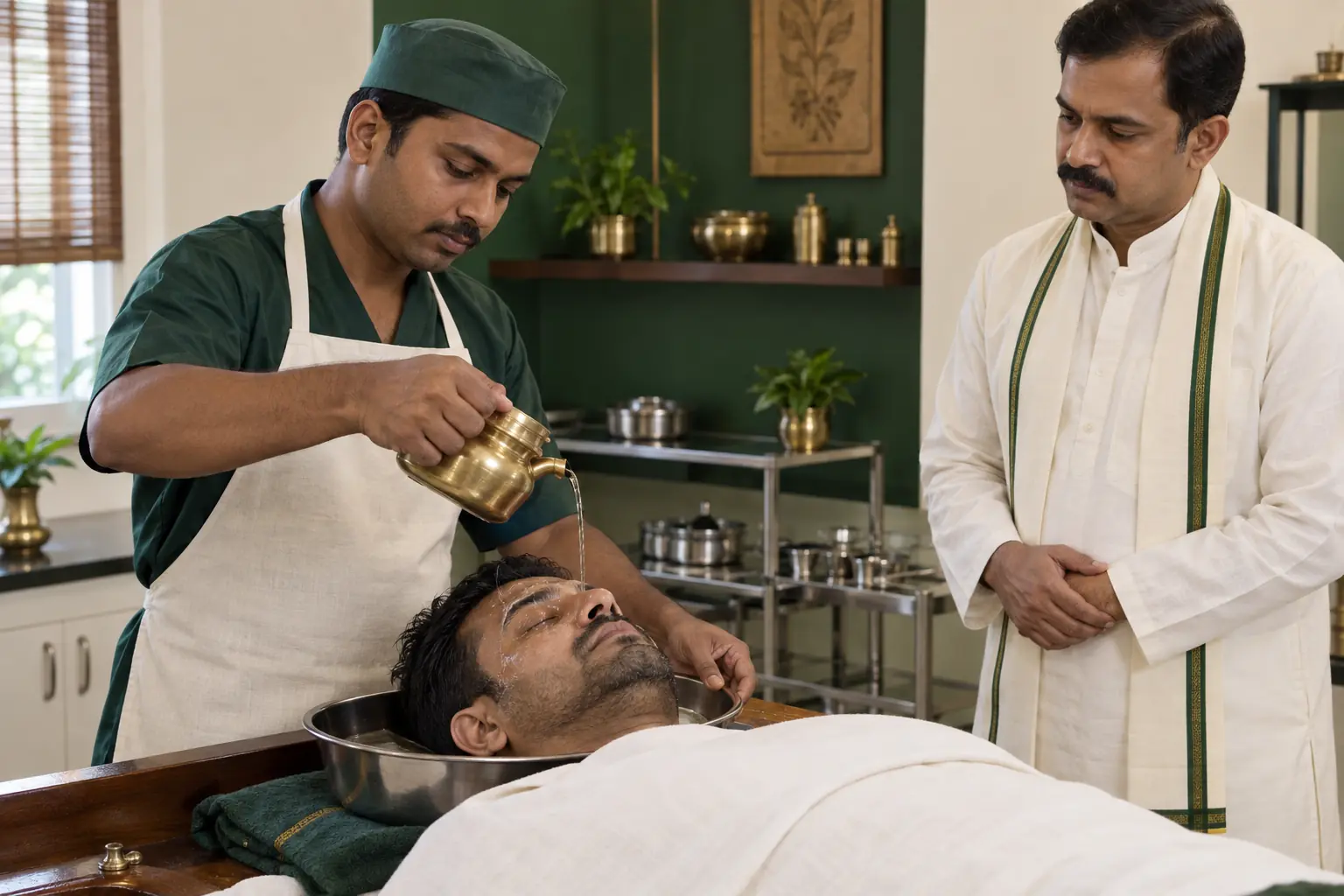
Netra Sekam is an external procedure described within Ayurvedic eye-care practice. A prescribed liquid preparation is poured gently and continuously over the closed eyelids from a controlled height.
The preparation, temperature, duration and technique are not the same for everyone. They should be selected according to the person’s symptoms, medical history, condition of the eye and surrounding skin, allergies and physician’s assessment.
The liquid should not be selected from an internet recipe. Preparations used near the eye require careful handling because contamination, incorrect temperature or unsuitable ingredients may cause irritation or injury.
How does Ayurveda traditionally describe Netra Sekam?
Ayurvedic literature places Seka or Parisheka among the external procedures used in Netra Kriyakalpa. Classical selection may vary according to the symptoms and the physician’s assessment of the individual.
This is a description of traditional Ayurvedic practice. It should not be interpreted as scientific confirmation that Netra Sekam treats a particular ophthalmic disease.
Why might an Ayurveda physician consider Netra Sekam?
A person may consult an Ayurveda physician for concerns such as:
- Eye fatigue
- Discomfort after prolonged screen exposure
- Mild heaviness around the eyes
- Watering or irritation
- A sensation of heat or burning
- Eyelid or surrounding-area discomfort
These symptoms can result from many causes, including dry eye disease, allergies, refractive errors, infection, inadequate sleep, environmental exposure or prolonged screen use.
An eye examination may therefore be necessary before any Ayurvedic procedure is considered. Netra Sekam should not be promoted as a proven treatment for cataract, glaucoma, retinal disease, infection or loss of vision.
How is Netra Sekam performed?
The exact protocol depends on the treating physician. A supervised session may broadly include the following stages.
1. Clinical assessment
The physician reviews:
- Current symptoms and their duration
- Previous eye conditions or surgery
- Allergies and skin sensitivity
- Contact-lens use
- Prescribed eye drops
- Current medicines and relevant medical conditions
The procedure may be postponed or avoided if symptoms suggest infection, injury or another condition requiring ophthalmic evaluation.
2. Preparation
The patient is positioned comfortably in a clean clinical treatment area. Contact lenses, eye makeup and cosmetic products around the eyes should be removed.
The physician determines the formulation, preparation method and suitable temperature.
3. Controlled application
The patient keeps the eyes gently closed. The prescribed liquid is poured in a controlled stream over the closed eyelids and surrounding area according to the treatment protocol.
The patient should report burning, pain, breathing difficulty, dizziness or any unexpected discomfort immediately.
4. Cleaning and observation
After the prescribed duration, the surrounding area is cleaned carefully. The physician or therapist observes the patient for redness, irritation, swelling or other adverse reactions.
Netra Sekam, Netra Tarpana and Bidalakam: what is the difference?
| Feature | Netra Sekam | Netra Tarpana | Bidalakam |
| Basic method | A prescribed liquid is poured over the closed eyelids in a controlled stream | A prescribed liquid preparation is retained around the eye area within a prepared boundary | A physician-selected paste is applied externally over the closed eyelids |
| Type of application | Flowing liquid | Retained liquid | External paste |
| Eye position | Generally closed during pouring | Depends on the prescribed protocol and stage | Closed |
| Procedure selection | Based on clinical assessment and suitability for pouring near the eyes | Based on suitability for liquid-retention therapy | Based on eyelid, surrounding-skin and symptom assessment |
| Important limitation | It is not a proven cure for eye disease | It should not be advertised as improving eyesight or removing spectacles | It should not be treated as a home remedy |
These procedures are not interchangeable. A person should not select one based solely on descriptions found online.
What does current scientific evidence show?
Published Ayurvedic literature describes the method of Netra Seka or Netra Parisheka. A small clinical study has also investigated Netra Parisheka as part of a combined intervention for dry-eye symptoms.
However, the available evidence has important limitations:
- Studies are few and generally small.
- Some assess combined treatments rather than Netra Sekam alone.
- Treatment formulations and methods are not fully standardised.
- Evidence is insufficient to establish effectiveness for specific eye diseases.
- Limited evidence cannot justify claims that it improves vision, removes spectacles or treats cataract, glaucoma or retinal disease.
Netra Sekam should therefore be presented as a traditional, physician-selected procedure whose clinical role remains uncertain—not as an established ophthalmic treatment.
Who may not be suitable for Netra Sekam?
The procedure may be unsuitable or require prior ophthalmic clearance when a person has:
- Sudden or unexplained vision changes
- Severe eye pain
- Eye injury or chemical exposure
- Active discharge or suspected infection
- Significant redness or swelling
- Open wounds or dermatitis around the eyes
- A known allergy to a proposed ingredient
- Recent eye surgery or another ophthalmic procedure
- Contact-lens-related pain or redness
- Glaucoma, retinal disease or another diagnosed eye disorder
Patients should tell the physician about pregnancy, breastfeeding, allergies, current medicines and prescribed eye drops.
Possible side effects and safety limitations
Possible unwanted effects may include:
- Burning or stinging
- Redness
- Watering
- Skin irritation
- Allergic reaction
- Discomfort from an unsuitable temperature
- Infection if materials or preparation methods are contaminated
Stop the procedure and inform the supervising clinician if unexpected discomfort develops.
“Natural” does not mean sterile, hypoallergenic or automatically safe for use near the eyes.
When is urgent medical evaluation required?
Seek prompt ophthalmic or emergency medical care for:
- Sudden or partial loss of vision
- Severe or rapidly worsening eye pain
- Chemical exposure or eye injury
- New flashes, floaters or a curtain-like shadow
- Marked light sensitivity
- Significant swelling or pus-like discharge
- Rapidly worsening redness
- Eye symptoms with severe headache, vomiting, weakness, facial drooping or speech difficulty
Sudden vision loss is a medical emergency and should not be managed by waiting for an Ayurvedic appointment. Cleveland Clinic advises immediate assessment for sudden loss of vision.
Can Netra Sekam be performed at home?
No. It should not be attempted using homemade herbal liquids or instructions from social media.
Important risks include:
- Incorrect ingredient selection
- Microbial contamination
- Excessively hot or cold liquid
- An allergic reaction
- Accidental eye exposure
- Delayed diagnosis of an underlying eye condition
Any preparation used close to the eyes should be selected and administered under appropriate professional supervision.
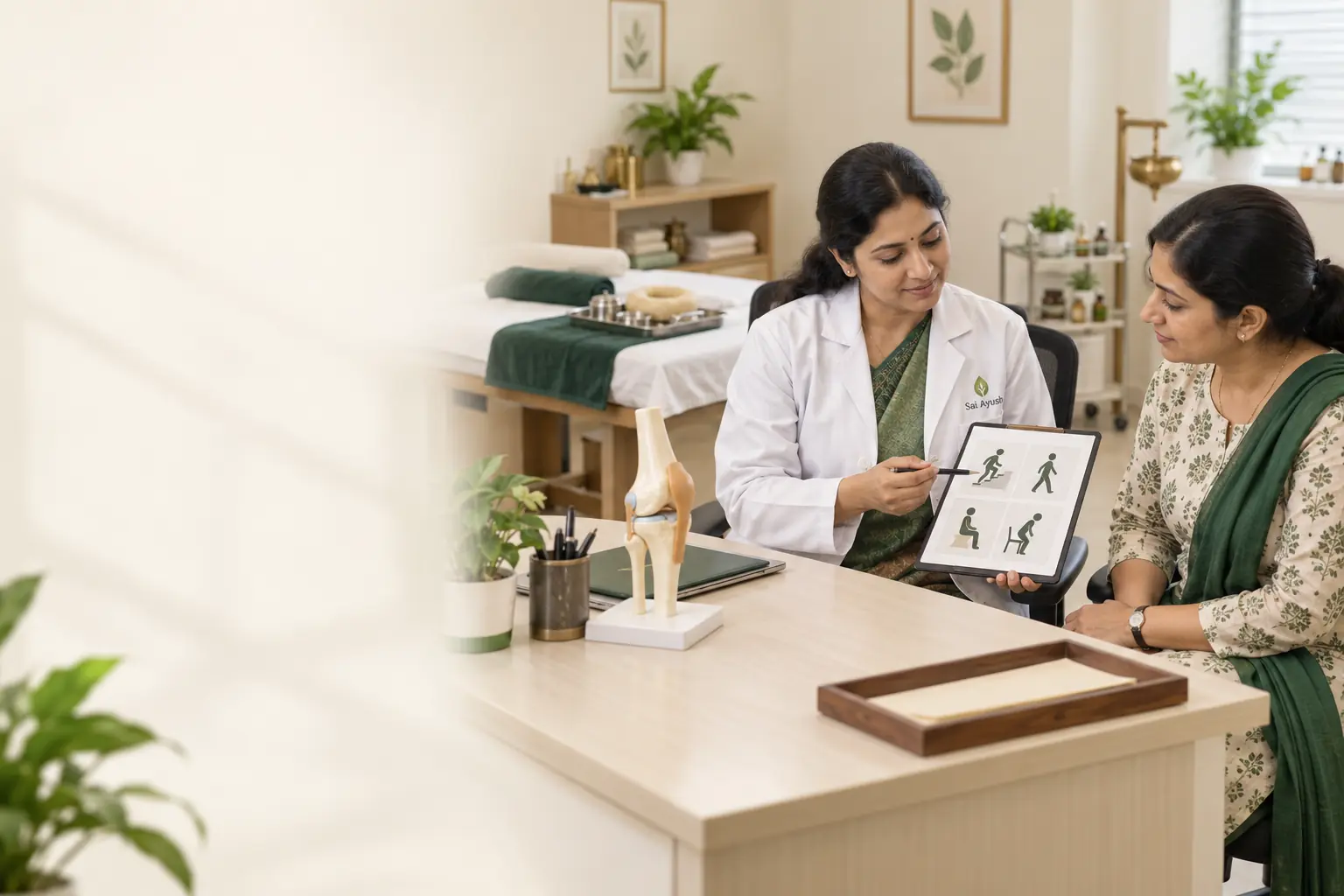
What should patients expect during consultation?
Before considering Netra Sekam, the Ayurveda physician should assess the symptoms, medical history, medicines, allergies and previous eye treatment.
Patients should bring:
- A list of current medicines and eye drops
- Previous eye reports, when relevant
- Details of eye surgery or procedures
- Information about contact-lens use
- Details of known allergies
An Ayurveda consultation does not guarantee that Netra Sekam will be recommended. The physician may instead advise an ophthalmologist’s examination.
Doctor-guided care at Sai Ayush
At Sai Ayush Ayurveda Hospital, an external Ayurvedic procedure should be recommended only after assessing the patient’s symptoms, history and suitability.
Patients may meet the Sai Ayush Ayurveda doctors for an individual consultation. When specialist eye evaluation is required, it should not be delayed in favour of an Ayurvedic procedure.
Frequently asked questions
Are Netra Sekam and Netra Dhara the same?
The terms are often used for a similar controlled pouring procedure over the closed eyelids. Terminology and protocols can vary between institutions, so the exact procedure should be confirmed with the treating physician.
Is Netra Sekam the same as Netra Tarpana?
No. Netra Sekam uses a flowing stream of a prescribed liquid. Netra Tarpana generally involves retaining a prescribed liquid preparation around the eye area within a specially prepared boundary.
Can Netra Sekam improve eyesight?
There is insufficient high-quality evidence to claim that it improves visual acuity, removes spectacles or treats serious eye disease.
Is Netra Sekam suitable for dry eyes?
Dry-eye symptoms can have several causes. Limited research does not establish Netra Sekam as a standard treatment for dry-eye disease. An appropriate eye examination should come first.
How many sessions are required?
There is no universal course suitable for everyone. If the procedure is considered appropriate, the physician determines its frequency and duration.
Should prescribed eye drops be stopped?
No. Do not stop or change eye drops or other medicines unless the prescribing clinician advises it.
Conclusion
Netra Sekam is a traditional external Ayurvedic procedure involving the controlled pouring of a prescribed liquid over closed eyelids. Its formulation, duration and suitability require individual clinical assessment.
Evidence remains limited, and the procedure should not be presented as a cure or substitute for ophthalmic diagnosis and treatment.
For persistent non-emergency symptoms, patients may arrange a consultation with a qualified Ayurveda physician. Sudden vision changes, severe pain, injury or significant infection symptoms require prompt conventional medical evaluation.
Medical disclaimer: This article provides general educational information and does not diagnose or treat any condition. Suitability and outcomes vary. Consult an appropriately qualified healthcare professional for individual advice.