

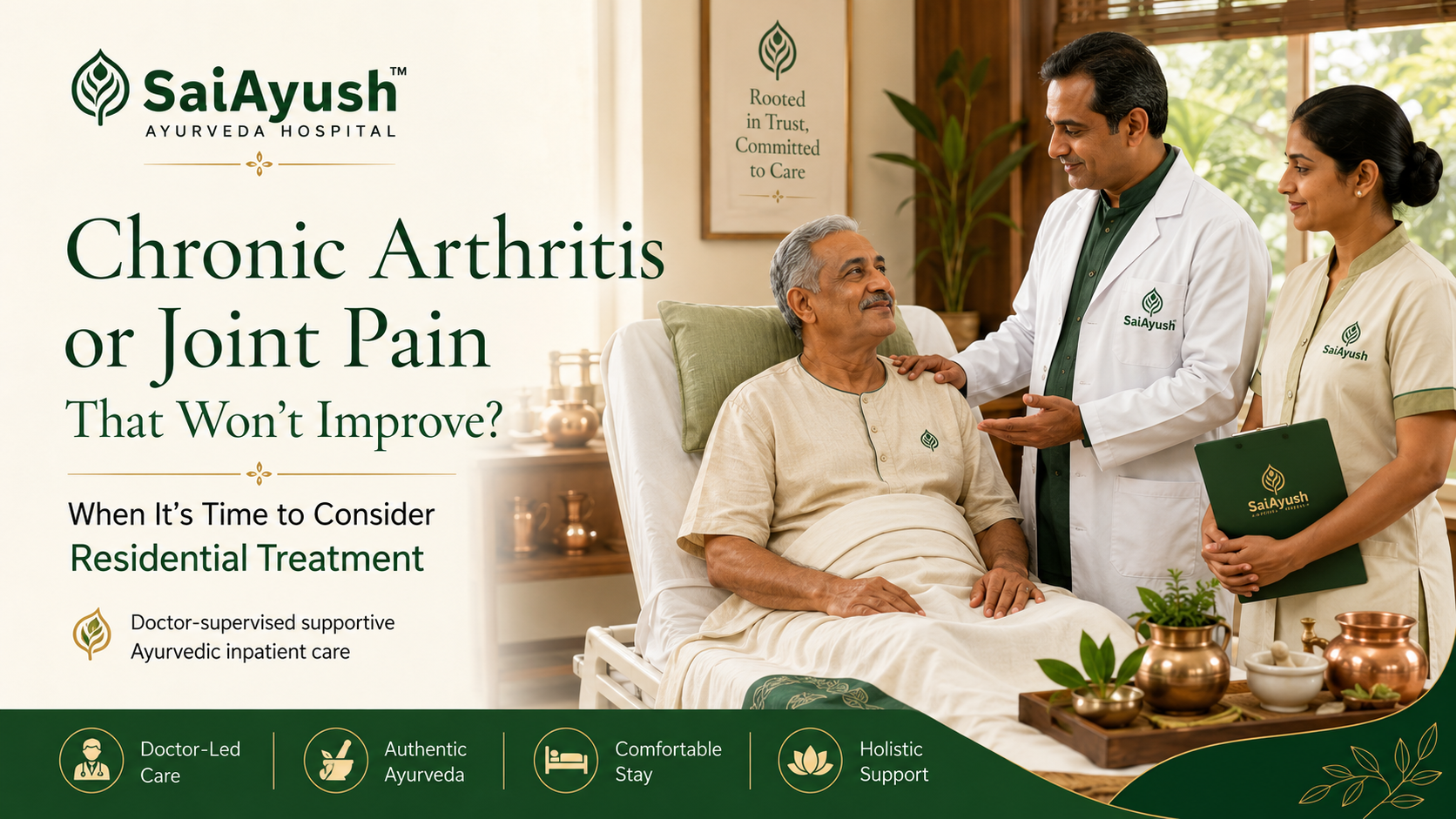
Chronic Arthritis or Joint Pain That Won't Improve? When It's Time to Consider Residential Treatment
Why does joint pain keep coming back?
For many people, arthritis and chronic joint pain are managed in fragments — a painkiller when it flares, a few therapy sessions, advice that's hard to follow at home. This can ease symptoms temporarily, but it rarely addresses the underlying pattern. In Ayurveda, persistent joint pain is often linked to aggravated Vata and accumulated toxins (ama) that need a sustained, structured process to clear — not a one-off session. When treatment is interrupted by daily routine, stress, irregular meals and poor rest, the pain tends to return. You can read about our overall approach on our Ayurvedic pain management page.
Signs that outpatient or home management may no longer be enough
Consider whether several of these apply to you:
- Painkillers are needed regularly just to get through the day, with diminishing relief
- The pain keeps returning after each round of treatment or therapy
- Stiffness or swelling is worsening, or spreading to more joints
- Pain is limiting daily activities — walking, climbing stairs, sleeping, working
- You've done outpatient therapy repeatedly without lasting improvement
- You can't realistically follow the prescribed diet, oils, rest and exercises at home
- You're relying on medication you'd rather reduce dependence on
If several of these are true, it's worth discussing whether a supervised, residential program is the more effective next step. Escalating your care when the current approach isn't working is a reasonable, responsible decision — not a failure.
Why does a residential program change the result?
The difference isn't a single "stronger" therapy — it's consistency and control. In a residential setting:
- Therapies are delivered daily and in the correct sequence (preparation, main procedures, recovery) rather than in occasional sessions
- The anti-inflammatory diet is prepared and supervised, not left to willpower at home
- Rest is protected — no work stress, no skipped routines, no interruptions
- The doctor monitors and adjusts treatment day by day based on your response
- Pain-relieving therapies, physiotherapy and lifestyle changes work together as one program
At Sai Ayush Ayurveda Hospital in Hyderabad, residential pain care follows our integrated ANP³ Method™ — Ayurveda, Naturopathy and Physiotherapy — under doctors with a 33+ year legacy and DMHO certification.
What therapies are used for chronic joint pain in a residential program?
A typical program is personalised, but commonly includes therapies such as Abhyanga (therapeutic oil massage), localised treatments like Janu Basti or Kati Basti (warm medicated oil pooled over the affected joint or lower back), Basti (medicated enema therapy, central to Vata-related conditions), targeted physiotherapy, and an anti-inflammatory diet with lifestyle and yoga guidance. The exact combination, intensity and duration are decided by the doctor after assessing your constitution (Prakriti) and current imbalance (Vikriti).
Pain not improving despite treatment? Speak to our team about a pre-admission assessment, or explore our Ayurvedic pain management and residential wellness packages. Residential admission is at our KPHB hospital; outpatient consultations are also available at our Madinaguda clinic.
How long is a residential program, and what results are realistic?
Programs commonly run from about one to three weeks depending on how long-standing and severe the condition is, with some people returning for a repeat cycle. Realistically, the goals are reduced pain and stiffness, better mobility and daily function, and reduced reliance on painkillers — supported, where appropriate, by a home routine to maintain the gains. Ayurveda is a complementary system of care; it does not promise a permanent cure, and outcomes vary between individuals. A good program sets clear, personalised goals with you and measures progress against them.
How is residential care different from just taking painkillers?
Painkillers manage the symptom; they don't address why the pain keeps returning. A residential Ayurvedic program aims at the underlying pattern — clearing accumulated toxins, calming aggravated Vata, strengthening the joint and correcting the diet and lifestyle factors that trigger flares. For many people with treatment-resistant pain, that shift from short-term symptom relief to a structured, root-cause program is what finally changes the trajectory.
Frequently asked questions
When should I consider inpatient treatment for arthritis?
When painkillers and repeated outpatient care no longer give lasting relief, when pain is limiting daily life, or when you can't realistically follow the prescribed diet and therapy at home. A doctor's assessment confirms whether residential care is right for you.
Can Ayurveda cure arthritis?
Ayurveda does not promise a permanent cure. A residential program aims to reduce pain and stiffness, improve mobility and reduce dependence on painkillers, as a complementary approach alongside your medical care. Results vary between individuals.
Will I have to stop my current medicines?
No — do not stop any prescribed medication without consulting your doctor. Share your current medicines and reports so the team can coordinate care safely.
How long is a typical residential program for joint pain?
Commonly about one to three weeks, depending on severity and how long the condition has persisted. Some people return for a repeat cycle. Your doctor will advise after assessment.
Is residential treatment only for severe cases?
Not necessarily, but it's most valuable when outpatient care hasn't worked, when pain is significantly affecting daily life, or when a supervised, disturbance-free setting is needed to follow the program properly.
Talk to our admissions team
Inpatient admission and residential programs are at our KPHB hospital — call +91 81423 28080.
Our Madinaguda location is a consultation clinic only (outpatient consultations: +91 84668 82266).
Ask about a pre-admission assessment for a residential joint pain or arthritis program.
Online & offline consultations available. Book a consultation.
Medical disclaimer
This article is for general information only and is not a substitute for professional medical advice, diagnosis or treatment. Ayurveda is offered here as a complementary system of care; it does not promise a cure for arthritis or chronic joint pain, and results vary between individuals. Always consult a qualified physician before starting treatment and do not stop prescribed medication without consulting your doctor.
Sources
- Ministry of AYUSH, Government of India — on Ayurvedic management of joint and Vata disorders
- World Health Organization — musculoskeletal conditions/osteoarthritis overview
Medically Reviewed By