


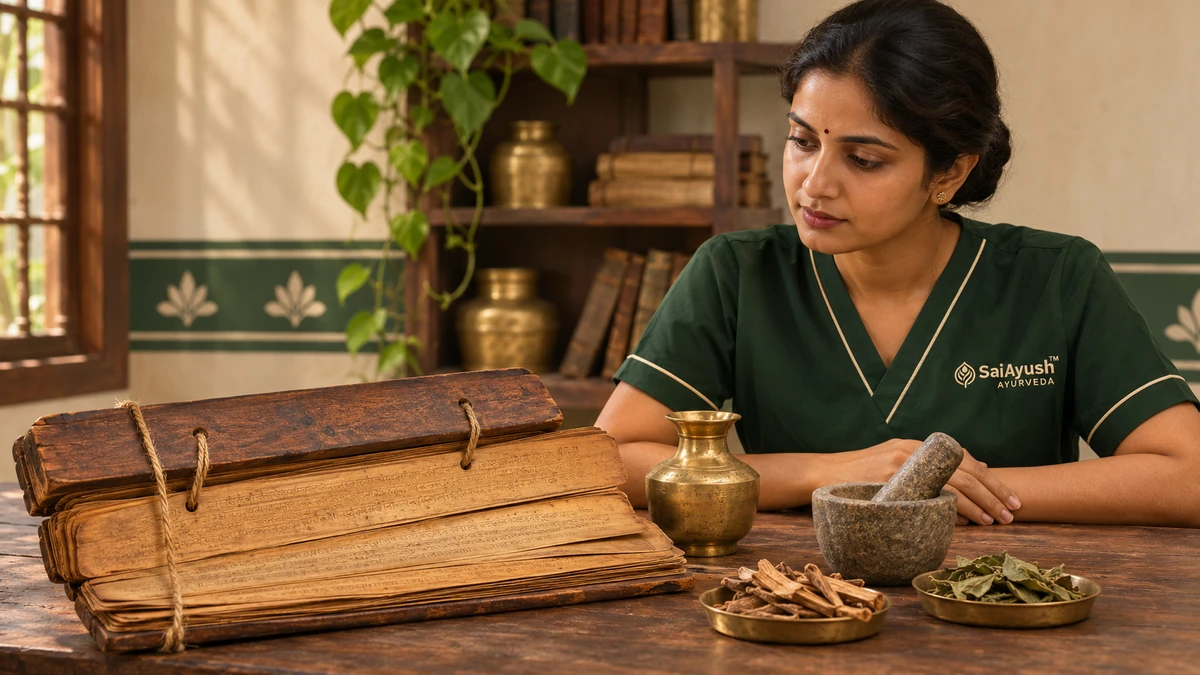
Where did Ayurveda come from? (Vedic roots)
Ayurveda's origins lie in the Vedas, the ancient body of Indian knowledge. Of the four Vedas — Rig, Sama, Yajur and Atharva — it is the Atharva Veda that contains the most references to disease, healing herbs, anatomy and health. For this reason Ayurveda is traditionally classified as an upaveda (a subsidiary branch of knowledge) attached to the Atharva Veda.
In this early period, healing knowledge was transmitted orally and was closely tied to lifestyle, diet, herbs and spiritual practice. The foundational idea — still central today — was that health is a state of balance, and that the body, mind and environment must be understood together rather than in isolation.
The classical age: the great texts
Ayurveda became a systematic science through a handful of foundational Sanskrit texts (samhitas, literally "collections"). Three are considered the great classical works — the Brihat Trayi ("the great triad"):
Charaka Samhita — the foundation of internal medicine
The Charaka Samhita is the most important surviving text on kaya-chikitsa (internal medicine). It is traditionally attributed to the sage Charaka and built upon an earlier work, the Agnivesha Tantra. Scholars generally place the text Charaka Samhita in roughly the 1st–2nd century CE, with a later revision by Dridhabala around the 4th century CE; some traditions date the underlying teachings much earlier.
It takes a strongly holistic approach — treating body, mind and spirit together — and emphasises prevention as much as cure. It also records remarkably detailed material: methods of diagnosis, the management of conditions such as diabetes, tuberculosis, asthma and arthritis, an account of fetal development, physician ethics (a code of conduct comparable in spirit to the Hippocratic Oath), and even guidance on how a good hospital should be built and run.
Sushruta Samhita — the foundation of surgery
The Sushruta Samhita, attributed to Sushruta, is the great classical text of shalya tantra (surgery). The surgical tradition it records is very old; the surviving text is generally dated by scholars to around the 3rd–4th century CE, with a later redaction associated with Nagarjuna.
It is extraordinary for its surgical scope: descriptions of around 125 surgical instruments, techniques of suturing, bandaging and extraction, cataract treatment, the management of fractures, and — most famously — rhinoplasty (reconstruction of the nose using a forehead flap), which is why Sushruta is often called "the father of plastic surgery." It also details 72 eye conditions and their treatment. Sushruta's own summary captures the Ayurvedic ideal: "Only the union of medicine and surgery constitutes the complete doctor."
Ashtanga Hridaya & Ashtanga Sangraha — the great synthesis
Around the 6th century CE, the scholar Vagbhata compiled two texts — the Ashtanga Sangraha (in prose) and the Ashtanga Hridaya (in verse, for memorisation). These brought together the internal-medicine tradition of Charaka and the surgical tradition of Sushruta into a single, accessible synthesis, with more emphasis on practical physiology. The Ashtanga Hridaya remains one of the most widely studied Ayurvedic texts to this day.
The eight branches of Ayurveda (Ashtanga Ayurveda)
The classical texts organised Ayurveda into eight branches (ashtanga = eight limbs), an early example of medical specialisation:
- Kaya-chikitsa — internal medicine
- Shalya tantra — surgery
- Shalakya tantra — diseases of the head and neck (eye, ear, nose, throat)
- Kaumara bhritya — paediatrics and obstetrics
- Agada tantra — toxicology
- Bhuta vidya — psychiatry / mental health
- Rasayana — rejuvenation and anti-ageing
- Vajikarana — fertility and reproductive health
(New to the subject? Start with our beginner's guide: What is Ayurveda? Treatments, Panchakarma and Benefits.)
The medieval period: refinement and pharmacology
In the centuries that followed, Ayurveda kept evolving. Physicians wrote influential new works — among them the Madhava Nidana (a landmark text on diagnosis), the Sharngadhara Samhita (pharmacy and formulations), and the Bhavaprakasha. A series of herbal lexicons (nighantus) catalogued close to 2,000 medicinal plants, adding new remedies and discarding ineffective ones. This was a living, self-correcting tradition — not a fixed set of rules.
Some of this knowledge later influenced modern medicine. A frequently cited example is Rauwolfia serpentina (Indian snakeroot), long used in Ayurveda, whose derivative became an early medicine for high blood pressure. India also has an early history of inoculation-style practices against smallpox, described long before similar methods became widespread elsewhere.
Decline under colonial rule
For much of its history Ayurveda was the mainstream system of care across the Indian subcontinent. During the colonial era, however, Western medical education became dominant and state support shifted away from indigenous medicine. Ayurveda was pushed to the margins — kept alive largely by traditional family lineages (vaidyas) and in rural communities — and declined as a formal system.
Revival and the modern era
After India gained independence in 1947, Ayurveda began a strong revival. New colleges and hospitals were established, training was standardised, and research institutions were set up. Today Ayurveda is a regulated system of medicine in India, with formal degrees (such as the B.A.M.S.), statutory councils, and government oversight through the Ministry of AYUSH (established in 2014 to govern Ayurveda, Yoga & Naturopathy, Unani, Siddha and Homoeopathy).
Interest in Ayurveda also spread internationally from around the 1970s, as Ayurvedic teachers from India travelled to the United States and Europe. Today it is studied and practised worldwide, and in many countries it is used as complementary care alongside modern medicine. Research into Ayurvedic approaches continues to grow, and bodies such as the US National Center for Complementary and Integrative Health (NCCIH) now publish evidence reviews on it.
Why this history still matters today
The history of Ayurveda is not just a story about the past — it explains how the system works now. Its enduring principles — treating the whole person, emphasising prevention and lifestyle, personalising care to the individual's constitution (prakriti, shaped by the three doshas), and using diet, herbs and therapies such as Panchakarma — all come directly from this 3,000-year tradition. At the same time, modern Ayurveda is practised by qualified, registered doctors and, at its best, works hand in hand with conventional medicine rather than replacing it. (For more on how these ancient roots carry into current practice, see Ayurveda: ancient wisdom for modern holistic health.)
Curious how these ancient principles are applied today? Explore our Ayurvedic wellness treatments and Panchakarma therapies, or meet our team of registered Ayurvedic doctors. Online and in-person consultations are available.
Frequently asked questions (FAQs)
How old is Ayurveda?
Ayurveda is more than 3,000 years old. Its roots lie in the Vedic period of ancient India, particularly the Atharva Veda, and it was later systematised in classical Sanskrit texts in the early centuries CE.
Who is the "father of Ayurveda"?
There is no single founder. Charaka is regarded as the key figure in Ayurvedic internal medicine, and Sushruta in surgery (he is often called "the father of plastic surgery"). The tradition is credited to many sages over a long period.
What are the oldest Ayurvedic texts?
The three great classical texts are the Charaka Samhita (internal medicine), the Sushruta Samhita (surgery), and Vagbhata's Ashtanga Hridaya and Ashtanga Sangraha (a synthesis of both). Together they are called the Brihat Trayi.
Is Ayurveda still practised today?
Yes. Ayurveda is a regulated system of medicine in India with formal degrees and government oversight (the Ministry of AYUSH), and it is practised worldwide, usually as complementary care alongside modern medicine.
Why did Ayurveda decline and then revive?
It was pushed to the margins during the colonial era when Western medicine became dominant. After India's independence in 1947, it was revived through new colleges, hospitals, standardised training and, later, dedicated government regulation.
Contact us
Sai Ayush Ayurveda Hospital — KPHB: +91 81423 28080 · Madinaguda: +91 84668 82266. Online and in-person consultations available. Explore our Ayurvedic wellness treatments and Panchakarma center.
References & further reading:
- Poliklinika Harni — History of Ayurveda: a Heritage of Healing .
- NCCIH (US National Center for Complementary and Integrative Health) — Ayurvedic Medicine: In Depth: https://www.nccih.nih.gov/health/ayurvedic-medicine-in-depth
- Ministry of AYUSH, Government of India: https://www.ayush.gov.in/
- Johns Hopkins Medicine — Ayurveda: https://www.hopkinsmedicine.org/health/wellness-and-prevention/ayurveda
- (For classical text datings, cite a peer-reviewed history-of-medicine source, e.g. Meulenbeld, G.J., A History of Indian Medical Literature, for the scholarly ranges used above.)
Medical disclaimer
This article is for educational purposes only and is not medical advice. It describes the history of Ayurveda; it is not a recommendation for any specific treatment. Ayurveda is offered as complementary care and is not a substitute for modern medical treatment for any condition. Consult a qualified practitioner before beginning any treatment.

Medically Reviewed By
Dr. P.V. Anjani (Pasalapudi Visalaanjani), B.A.M.S, M.D. (Kayachikitsa), Reg. 1146/A/2016
Updated on November 16, 2026
This article is for educational purposes only and does not constitute medical advice. Please consult a qualified healthcare professional before beginning any treatment. If you are experiencing a medical emergency, contact your nearest hospital immediately.