
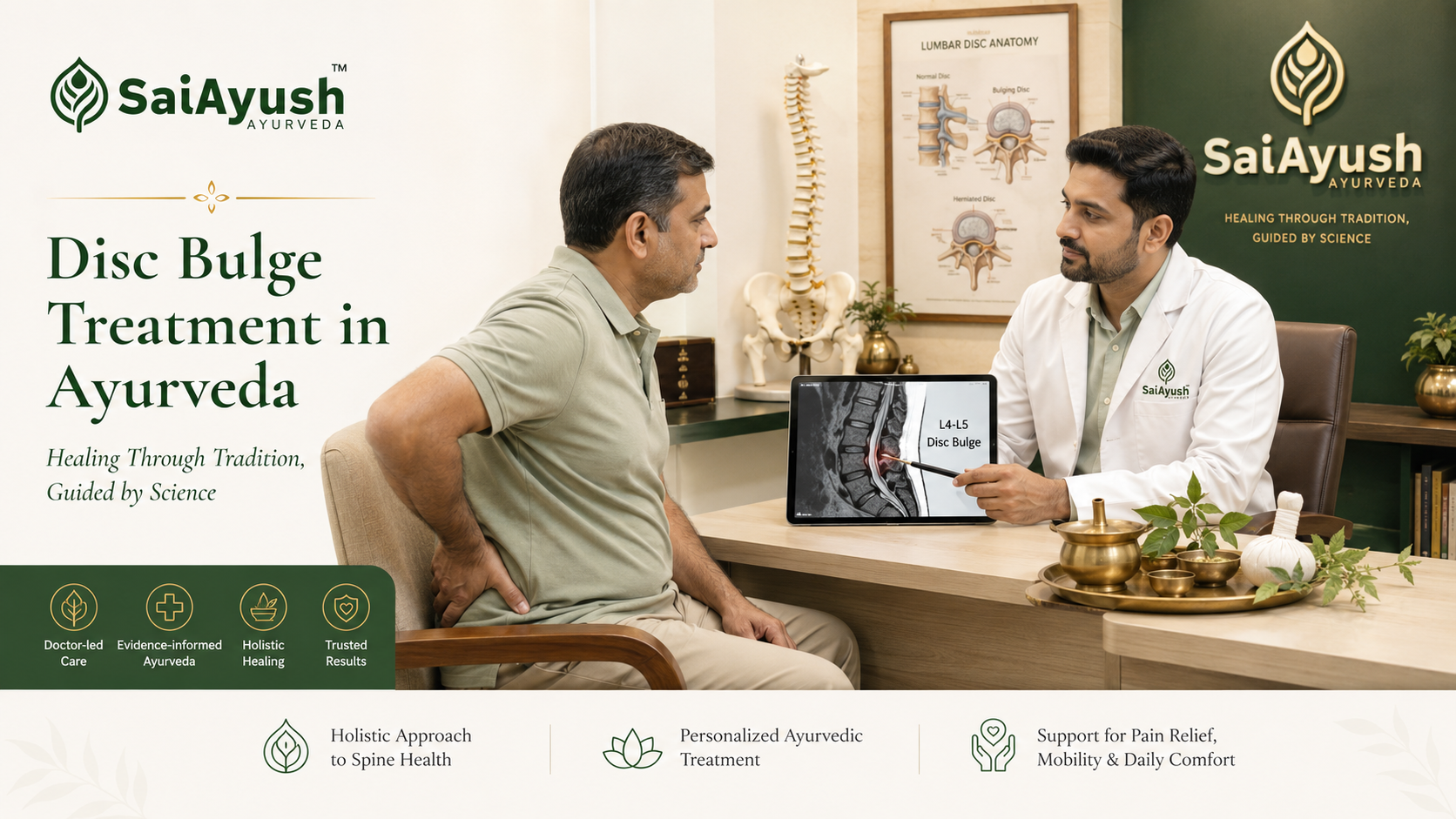
## What is a disc bulge? A disc bulge happens when one of the soft cushion-like discs between the spinal bones moves outward from its normal position. These discs act like shock absorbers for the spine. When a disc bulges, it may press or irritate nearby nerves and cause pain, stiffness, tingling, numbness, or radiating discomfort. A disc bulge can occur in the lower back, called the lumbar spine, or in the neck, called the cervical spine. A lumbar disc bulge may cause lower back pain and pain going toward the buttock, thigh, calf, or foot. A cervical disc bulge may cause neck pain, shoulder pain, arm pain, tingling, or numbness in the hand. Not every disc bulge causes severe pain. Some people may have a disc bulge on MRI but only mild symptoms. Others may experience pain that affects sitting, walking, bending, lifting, sleeping, or daily work. This is why treatment should be planned based on symptoms, examination, reports, lifestyle, and nerve involvement — not only based on MRI words like "mild bulge" or "protrusion." ## Ayurvedic understanding of disc bulge In Ayurveda, many disc-related pain patterns are understood through Vata imbalance, stiffness, dryness, restricted movement, nerve irritation, and tissue weakness. However, the practical treatment plan should be personalised. One patient may have lower back pain with muscle tightness. Another may have radiating leg pain. Another may have cervical disc bulge with arm tingling. Another may have chronic stiffness with lumbar spondylosis. These patients should not receive the same therapy in the same way. At Sai Ayush Ayurveda Hospital, doctors assess pain location, duration, movement restriction, sleep, digestion, lifestyle, occupation, previous reports, and nerve symptoms. Based on this, a suitable Ayurvedic and supportive spine-care plan may be recommended. ## How doctor-guided Ayurvedic care may support disc bulge Ayurvedic care for disc bulge may support comfort, stiffness reduction, muscle relaxation, mobility, and long-term spine care in suitable cases. The aim is not to make unsafe promises but to plan structured care according to the patient’s condition. ### Kati Basti Kati Basti is a traditional Ayurvedic therapy where warm medicated oil is retained over the lower back for a specific duration. It is commonly used in Ayurveda practice for lower back stiffness, Vata-related pain patterns, and lumbar spine discomfort. ### Greeva Basti For cervical disc-related symptoms, Greeva Basti may be considered. In this therapy, warm medicated oil is retained over the neck region. It should be done only after assessment, especially if the patient has severe pain, arm numbness, or nerve-related symptoms. ### Abhyanga and Swedana Therapeutic oil application and controlled fomentation may help relax tight muscles in suitable cases. The type of oil, pressure, heat level, and duration should be selected carefully. Some pain patterns may benefit from warmth, while others may need a different approach. ### Patra Pinda Sweda This therapy uses warm herbal boluses and may be considered in stiffness-dominant musculoskeletal pain patterns. It is not suitable for every disc bulge case and should be planned by the physician. ### Basti-based Panchakarma In selected chronic Vata-related pain patterns, doctors may consider Basti-based Panchakarma. Panchakarma is not required for every patient. Suitability depends on severity, strength, age, digestion, pain pattern, and associated symptoms. To understand Panchakarma services, visit: Panchakarma Treatments in Hyderabad. ## Role of physiotherapy, posture, and lifestyle correction Disc bulge care should not depend only on medicines or therapies. In many patients, long-term improvement also needs posture correction, safe movement, strengthening, and lifestyle modification. A structured plan may include: * Avoiding long continuous sitting * Correcting laptop and mobile posture * Learning safe bending and lifting techniques * Gradual strengthening of core and back muscles * Weight management where needed * Sleep and mattress guidance * Stress management and breathing practices * Avoiding sudden forward bending during acute pain * Avoiding self-selected gym exercises during painful phases If exercises increase pain, tingling, numbness, or leg/arm symptoms, stop and consult a doctor or physiotherapist. ## Can disc bulge be managed without surgery? Many disc bulge cases are managed conservatively, especially when symptoms are mild to moderate and there are no emergency signs. Conservative care may include rest for a short period, guided movement, physiotherapy, posture correction, pain management, and doctor-guided therapies. However, some cases may need urgent specialist evaluation. Progressive weakness, bladder or bowel symptoms, severe nerve compression, saddle numbness, trauma, infection, or worsening neurological signs should not be delayed. Ayurveda may support spine health and symptom management in suitable cases, but no ethical healthcare provider should promise guaranteed surgery avoidance without proper evaluation. ## Daily care tips for people with disc bulge These are general tips and do not replace medical advice: * Avoid sitting continuously for more than 30–45 minutes during painful phases. * Use a chair with proper back support. * Keep the spine neutral while working. * Avoid lifting heavy objects during acute pain. * Do not bend suddenly from the waist. * Avoid sleeping on very soft mattresses. * Use stairs carefully if leg pain or weakness is present. * Avoid aggressive massage, forceful stretching, or sudden twisting. * Do not start gym workouts without professional guidance. * Consult a doctor if pain spreads to the leg or arm. ## Who may consider Ayurvedic consultation for disc bulge? You may consider consultation if you have: * MRI-reported disc bulge with back or neck pain * Lower back pain spreading to the leg * Neck pain spreading to the shoulder or arm * Tingling, numbness, or burning sensation * Repeated stiffness after sitting or sleeping * Difficulty bending, lifting, walking, or sitting * Chronic pain that keeps returning * Mild to moderate symptoms without emergency red flags At Sai Ayush Ayurveda Hospital, KPHB and Madinaguda, doctors evaluate the condition and suggest whether outpatient care, inpatient care, Panchakarma, physiotherapy guidance, posture correction, or further medical evaluation is suitable. To explore broader spine-related services, visit: Pain and Spine Treatments. To meet the team, visit: Ayurvedic Doctors in Hyderabad. To book a consultation, visit: Contact Sai Ayush Ayurveda Hospital. ## Final thoughts Disc bulge should not be treated casually, especially when pain spreads to the leg or arm, causes numbness, or affects walking, sitting, sleep, or work. Temporary relief may help for a few days, but long-term spine care needs proper evaluation, posture correction, safe movement, and a personalised treatment plan. Doctor-guided Ayurvedic care may support pain management, stiffness reduction, mobility, and lifestyle correction in suitable cases. If your symptoms are recurring or worsening, consult a qualified physician instead of relying only on self-care. For detailed treatment information, visit: Ayurvedic Disc Bulge Treatment in Hyderabad. ## FAQs ### 1. What are the common symptoms of disc bulge? Common symptoms may include back pain, neck pain, stiffness, radiating leg or arm pain, tingling, numbness, burning sensation, and difficulty sitting, bending, walking, or sleeping comfortably. ### 2. Is disc bulge the same as slip disc? They are related but not always exactly the same. Disc bulge usually means the disc has extended outward, while slip disc or herniated disc may involve the inner disc material pushing out through the outer layer. MRI findings and symptoms should be reviewed by a doctor. ### 3. Can Ayurveda help in disc bulge? Ayurvedic care may support stiffness reduction, muscle relaxation, comfort, mobility, and spine health in suitable cases. The plan should be personalised after doctor evaluation. ### 4. Is Kati Basti useful for disc bulge? Kati Basti is commonly used in Ayurveda practice for lower back stiffness and Vata-related pain patterns. Its suitability depends on the patient’s symptoms, severity, and doctor assessment. ### 5. Should I take massage for disc bulge pain? Random massage is not advisable for every disc bulge case. If there is nerve irritation, severe pain, numbness, weakness, or disc compression, aggressive massage may worsen symptoms. Consult a doctor first. ### 6. When is disc bulge serious? Disc bulge symptoms need urgent medical attention if there is bladder or bowel difficulty, progressive weakness, saddle numbness, severe injury-related pain, fever, unexplained weight loss, or worsening neurological symptoms. ### 7. Can disc bulge cause sciatica? Yes, a lumbar disc bulge may irritate a nerve root and cause pain that travels from the lower back to the buttock, thigh, calf, or foot. This pattern is often called sciatica. ### 8. Does every disc bulge need surgery? No. Many disc bulge cases are managed conservatively, depending on symptoms and severity. However, severe nerve compression or emergency red flags may need urgent specialist evaluation.
Medically Reviewed By