

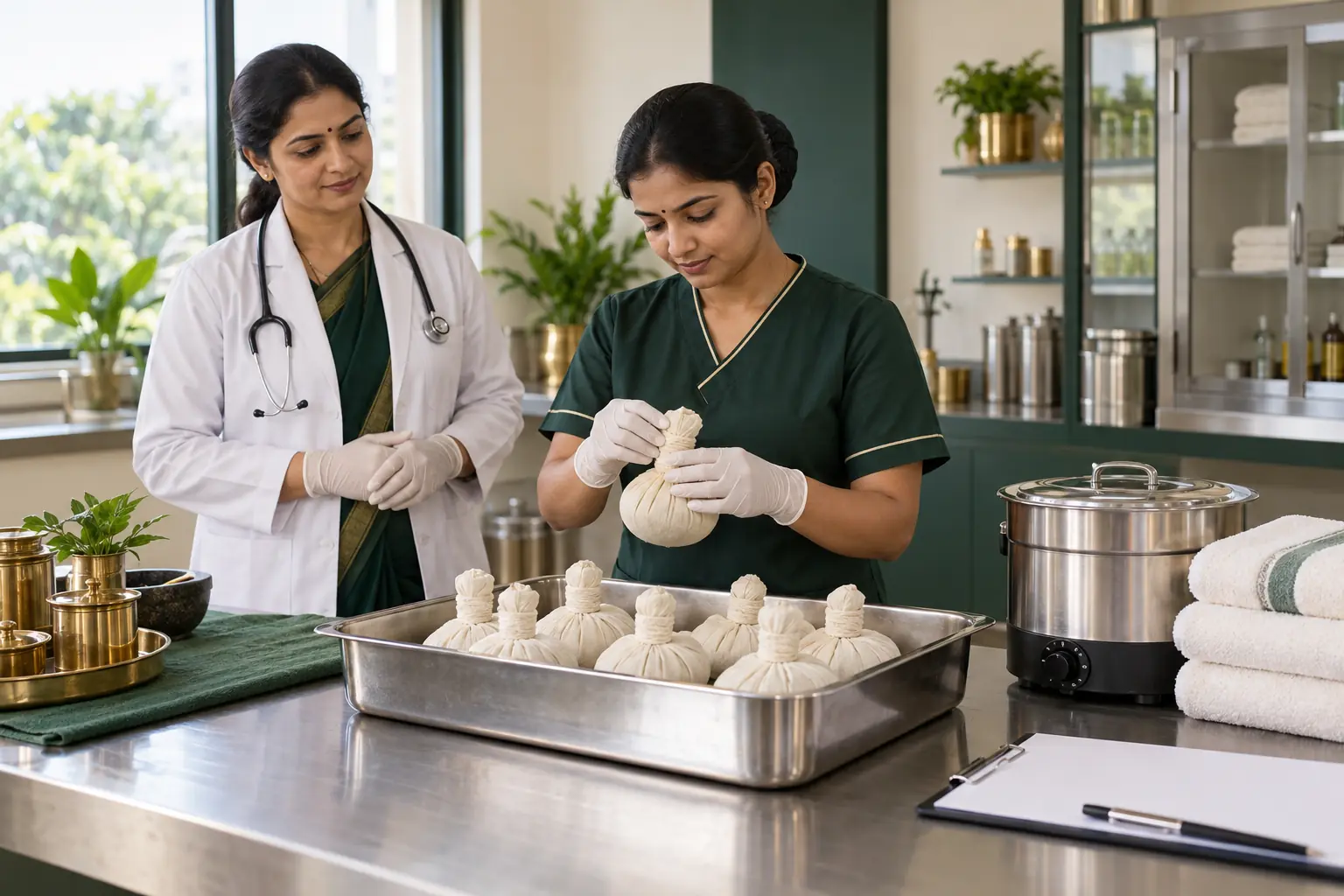
Mamsa Kizhi, also called Mamsa Pinda Sweda, is a specialised external Ayurvedic fomentation procedure. Warm cloth boluses containing physician-selected and specially processed meat preparations may be applied to particular areas of the body.
In classical Ayurvedic practice, this therapy may be considered in selected individuals who require a nourishing form of external fomentation. It is not suitable for everyone and should not be chosen from a treatment menu without an Ayurveda physician’s assessment.
Mamsa Kizhi is an external supporting therapy. It is not one of the five principal Panchakarma procedures.
What Does Mamsa Kizhi Mean?
The name can be understood as:
- Mamsa: meat
- Kizhi: the Malayalam word for a cloth bundle or bolus
- Pinda: bolus
- Sweda: therapeutic application of warmth or fomentation
The exact ingredients and method can vary according to the physician’s prescription, the individual’s health and the intended treatment area.
Patients should be informed clearly that the bolus contains an animal-derived ingredient. Consent should be obtained before preparation or application.
How Is Mamsa Kizhi Prepared?
A prescribed meat preparation may be processed with a physician-selected liquid medium or other ingredients. It is then placed inside clean cloth and tied into boluses.
The preparation must follow appropriate hygiene and temperature-control procedures. The ingredients should not be presented as a standard formula because selection can vary between patients and clinical traditions.
Before therapy, the healthcare team should confirm:
- The physician’s written prescription
- Ingredients being used
- Patient consent
- Relevant food or skin allergies
- Skin condition over the treatment area
- Sensitivity to heat
- General medical suitability
- Infection-control requirements
How Is the Procedure Performed?
The procedure may involve the following steps:
- A qualified Ayurveda physician evaluates the patient.
- The intended treatment area is examined.
- The patient is informed that meat-based boluses will be used.
- Prescribed boluses are prepared hygienically.
- The boluses are warmed to a safe, tolerable temperature.
- They are applied using controlled pressure and movement.
- Temperature and skin response are checked repeatedly.
- The area is cleaned after the procedure.
- The physician or clinical team reviews the patient’s response.
Treatment duration, temperature, pressure and number of sessions must be individualised. They should not be fixed solely from an online description.
Why May a Physician Consider Mamsa Kizhi?
In Ayurvedic practice, Mamsa Kizhi may be considered as a nourishing external procedure in selected musculoskeletal or neuromuscular care plans.
Traditionally intended supportive goals may include:
- Providing controlled warmth to selected tissues
- Supporting relaxation of stiff muscles
- Supporting physical comfort
- Providing a nourishing external fomentation
- Complementing a broader rehabilitation programme
These are traditional therapeutic intentions, not guaranteed clinical outcomes.
Mamsa Kizhi should not be described as rebuilding muscles, regenerating nerves, curing paralysis, reversing muscular dystrophy or permanently relieving pain. Evidence is currently insufficient for such claims.
Is Mamsa Kizhi a Massage?
It is better described as bolus fomentation than as a routine massage. The procedure combines warmth, the prescribed bolus material and controlled physical application.
It should not be confused with:
- Abhyanga, which involves therapeutic oil application
- Navara Kizhi, which generally uses processed rice
- Ela Kizhi, which uses selected leaves
- Podi Kizhi, which uses herbal powders
- Naranga Kizhi, which uses processed citrus ingredients
The physician selects a therapy based on clinical assessment rather than assuming that all Kizhi procedures have the same purpose.
Who May Be Considered?
A physician might consider this procedure for selected adults as part of an individualised plan. The decision may depend on:
- The person’s diagnosis and present symptoms
- Strength and nutritional status
- Skin condition
- Heat tolerance
- Sensation over the proposed treatment area
- Current medicines
- Existing medical conditions
- Rehabilitation requirements
- Personal, religious and dietary preferences
The presence of muscle weakness alone does not automatically make someone suitable for Mamsa Kizhi. The underlying reason for weakness should first be evaluated.
When May It Be Unsuitable?
Mamsa Kizhi may need to be avoided or postponed in people with:
- Fever or active systemic infection
- Open wounds, burns or active skin infection
- Acute injury with significant heat, redness or swelling
- Known allergy to an ingredient
- Markedly reduced skin sensation
- Poorly controlled medical conditions
- Severe weakness or dehydration
- Inability to communicate discomfort
- A personal or religious objection to animal-derived ingredients
People with diabetes, peripheral neuropathy, circulation problems, bleeding disorders or significant heart disease require particular medical caution.
Pregnant patients, children, frail older adults and people recovering from surgery require individual assessment before any heat-based procedure.
Possible Risks and Side Effects
Potential risks include:
- Excessive heat or burns
- Skin irritation
- Allergic reaction
- Increased pain or discomfort
- Dizziness or fatigue
- Infection or cross-contamination if hygiene is inadequate
- Discomfort arising from smell or the animal-derived ingredients
The therapist should stop the procedure if the patient experiences excessive burning, pain, dizziness, breathlessness, nausea or unusual discomfort.
Hygiene and Consent Are Essential
Because Mamsa Kizhi uses biological material, preparation, handling and disposal require particular care.
The clinical team should use:
- Fresh, appropriately sourced ingredients
- Clean preparation surfaces
- Suitable storage and temperature control
- Fresh cloth and patient-specific boluses
- Hand hygiene and protective measures
- Safe disposal after treatment
A bolus prepared for one patient should never be reused for another patient.
The patient must be informed about the ingredients before treatment. A vegetarian patient or anyone with religious or personal concerns should be offered a discussion about possible alternatives. No patient should be pressured to accept an animal-derived therapy.
What Does the Scientific Evidence Show?
Published literature on Mamsa Kizhi is limited. Some reports describe its use as one component of a broader Ayurvedic programme, but these reports cannot establish that Mamsa Kizhi alone caused the outcome.
For example, a 2025 case report described Mamsa Pinda Sweda alongside several other Ayurveda interventions in one patient with a rare neuromuscular condition. A single case report involving multiple treatments cannot prove effectiveness or establish general treatment recommendations. Read the case report.
Pinda Sweda is described more generally as a form of warm bolus application, with the bolus contents varying by procedure. Kerala Tourism’s Ayurveda overview explains the broader method but does not establish the effectiveness of Mamsa Kizhi for a specific disease.
Better-controlled clinical research is needed before firm conclusions can be made about its effectiveness.
Questions to Ask Before Treatment
Ask the treating physician:
- Why are you recommending Mamsa Kizhi?
- What ingredients will be used?
- Are animal-derived materials included?
- What benefit can reasonably be expected?
- Are there vegetarian alternatives?
- What are the possible risks?
- How will temperature and hygiene be controlled?
- Will this be combined with physiotherapy or other care?
- Should I continue my current medicines?
- What symptoms require stopping treatment?
Mamsa Kizhi at Sai Ayush
At Sai Ayush, any specialised Kerala Ayurveda therapy should be considered only after consultation with a qualified Ayurveda physician. The doctor reviews the patient’s symptoms, diagnosis, medical history, medicines, reports and suitability before recommending a procedure.
Learn more about the Sai Ayush Ayurveda doctors, the general Panchakarma approach, or the KPHB hospital.
Conclusion
Mamsa Kizhi is a specialised, meat-based external fomentation used within certain Ayurvedic clinical traditions. Its suitability depends on physician assessment, informed consent, ingredient transparency, safe temperature control and strict hygiene.
It should be presented as a supportive, individually selected therapy—not a proven cure for muscle loss, neurological disease, paralysis or chronic pain.
Medical disclaimer: This article is for general education only. It does not provide a diagnosis or personalised treatment recommendation. Do not stop prescribed medicines, delay investigations or postpone necessary medical care based on this information.
Medically Reviewed By
Dr. Pasalapudi Visalaanjani, B.A.M.S, MD (Kayachikitsa), Reg No: 1146/A/2016
Updated on september 09,2026