
Disc Bulge and Ayurvedic Treatment: What Patients Should Know
A disc bulge found on an MRI can be concerning, particularly when the report uses terms such as “nerve compression,” “thecal-sac indentation” or “foraminal narrowing.” However, a scan finding alone does not determine how serious the condition is or which treatment is appropriate.
Some disc bulges cause back or neck pain, radiating pain, numbness or weakness. Others are discovered incidentally and may not be responsible for the person’s symptoms.
Ayurvedic care may be considered as supportive treatment for selected patients after proper assessment. It should not be promoted as a method that pushes a disc back into position, permanently reverses degeneration, guarantees avoidance of surgery or treats emergency nerve compression.
What is a disc bulge?
Intervertebral discs sit between the bones of the spine and help absorb load while allowing movement. Each disc contains a softer central region surrounded by a tougher outer layer.
A disc bulge occurs when part of the disc extends beyond its usual boundary. A bulging disc may occur in the:
- Cervical spine, or neck
- Thoracic spine, or middle back
- Lumbar spine, or lower back
The presence of a bulge does not automatically mean that a nerve is compressed. Its clinical importance depends on its location, size, relationship to nearby nerves and whether it corresponds with the person’s symptoms and examination findings.
Is a disc bulge the same as a slipped or herniated disc?
These terms are often used interchangeably, but they may describe different changes.
A broad disc bulge generally involves the disc extending outward over a wider area. A disc herniation usually refers to a more localised displacement of disc material. “Slipped disc” is a common non-technical term used for a bulging, prolapsed or herniated disc.
The terminology in an MRI report should be interpreted by an appropriately qualified clinician. Treatment should not be selected from the wording of the report alone.
What symptoms can a disc bulge cause?
A disc bulge may cause no symptoms. When it irritates or compresses a nerve, symptoms depend on the spinal region involved.
Possible lumbar disc symptoms
A lumbar disc problem may cause:
- Lower-back pain
- Pain spreading into the buttock, thigh, calf or foot
- Tingling or numbness in the leg
- Burning or electric-shock-like pain
- Leg or foot weakness
- Difficulty sitting, bending or walking
- Pain that worsens with coughing or sneezing
Pain travelling down the leg may be associated with sciatica, although sciatica can have other causes.
Possible cervical disc symptoms
A cervical disc problem may cause:
- Neck pain or stiffness
- Pain spreading into the shoulder, arm or hand
- Tingling or numbness in the arm or fingers
- Reduced grip strength
- Arm or hand weakness
- Difficulty with fine hand movements
Pain, tingling or weakness should be clinically assessed rather than assumed to arise from muscular tension alone.
Why do MRI findings and pain not always match?
Imaging can reveal structural changes, but it does not measure the person’s pain experience or function.
A person may have a disc bulge on MRI without significant symptoms. Another person may experience severe radiating pain from nerve irritation even when the scan description appears less dramatic.
For this reason, a doctor considers three sources of information together:
- The patient’s symptoms and their pattern
- Physical and neurological examination findings
- Imaging or other investigations when clinically required
Repeating an MRI is not automatically necessary whenever pain returns. The need for imaging depends on symptoms, examination findings, previous reports and the possibility of a serious underlying condition.
How does a doctor assess a patient with a disc bulge?
A safe assessment should take place before massage, heat, spinal manipulation, exercise or an Ayurvedic procedure is recommended.
Symptom history
The physician may ask:
- When did the pain begin?
- Was there an injury, fall or lifting incident?
- Is the pain restricted to the back or neck?
- Does it travel into an arm or leg?
- Is there tingling, numbness or weakness?
- Which activities worsen or reduce it?
- Does it disturb sleep?
- Is the condition improving, stable or worsening?
Neurological assessment
Where appropriate, the examination may include:
- Muscle strength
- Sensation
- Reflexes
- Walking and balance
- Nerve-tension tests
- Hand coordination
- Bladder and bowel symptoms
Progressive weakness or changes in bladder, bowel or saddle-area sensation require urgent conventional medical assessment.
Medical history
Diabetes, osteoporosis, cancer history, infection risk, pregnancy, long-term steroid use, recent surgery and current medicines may affect both diagnosis and treatment safety.
Review of reports
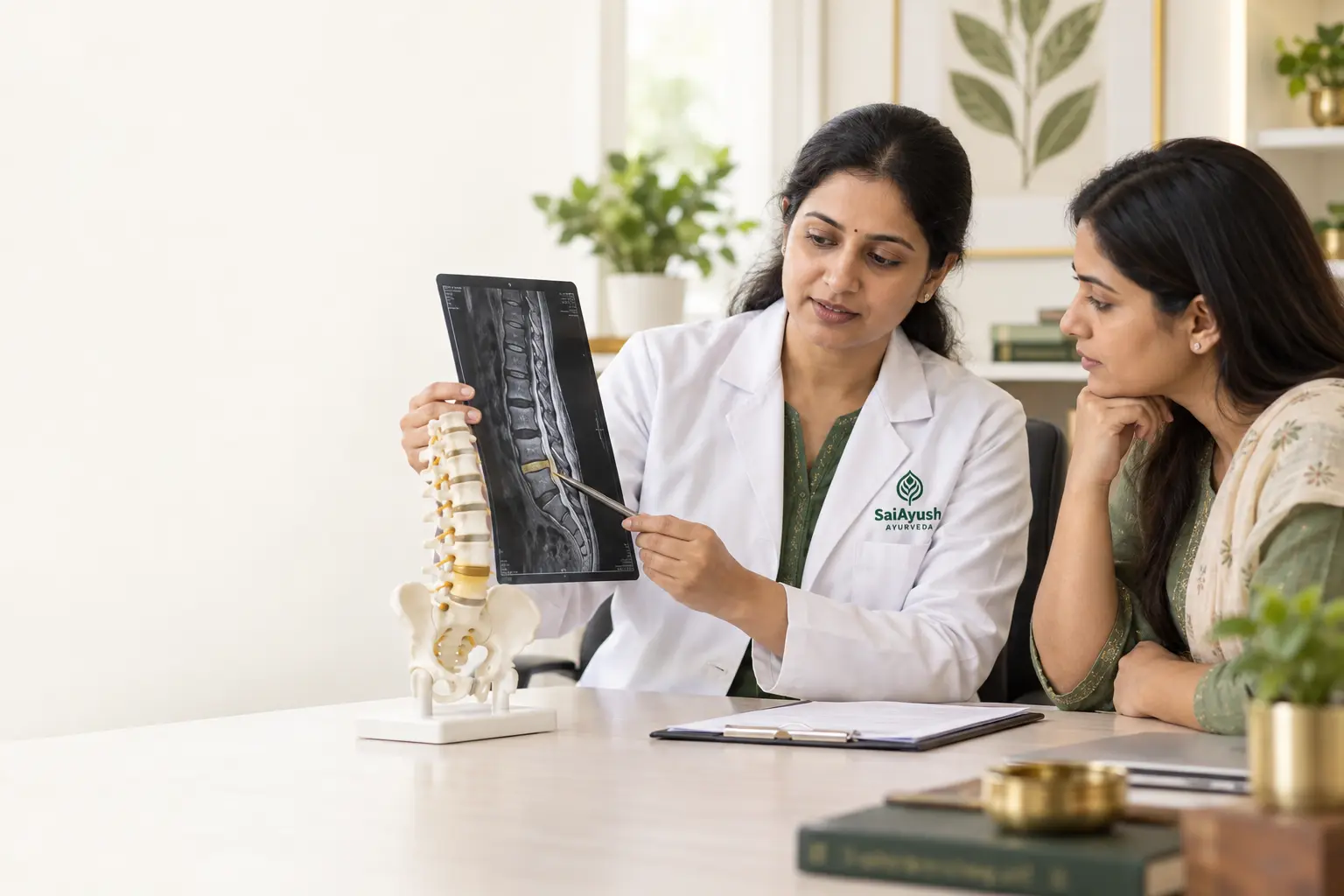
Patients should bring available MRI, X-ray and specialist reports. The doctor should correlate the imaging with the clinical findings rather than treating the scan in isolation.
How is disc-related pain viewed in Ayurveda?
Ayurvedic physicians may traditionally interpret pain, stiffness, restricted movement and radiating symptoms through concepts involving Vata and the condition of the supporting tissues.
This framework may help guide an individual Ayurvedic plan, but it does not replace neurological assessment or anatomical diagnosis. A disc bulge should not automatically be classified as a single dosha disorder, and the same treatment should not be given to every patient.
The physician must first determine:
- Whether symptoms are primarily mechanical, muscular or nerve-related
- Whether the problem is acute or longstanding
- Whether heat and pressure are appropriate
- Whether movement should be modified
- Whether investigation or specialist referral is required
- Whether Ayurveda should be primary supportive care or part of an integrated plan
What may doctor-guided Ayurvedic care include?
If no emergency or contraindication is identified, an Ayurveda physician may consider supportive care according to the patient’s symptoms and medical history.
Activity and posture guidance
Advice may include modifying aggravating activities, taking breaks from prolonged sitting and improving lifting or workstation habits.
Extended bed rest is generally not recommended for uncomplicated disc-related pain. Movement should be continued or gradually resumed as tolerated, following professional guidance.
Individualised external procedures
A physician may consider selected oil applications, localised procedures or mild fomentation for muscular tightness and stiffness.
These procedures do not mechanically push a disc back into place or decompress a spinal nerve. Their possible role should be described as supportive symptom management.
Treatment temperature, pressure, duration and frequency must be chosen individually.
Physiotherapy and rehabilitation
Appropriate rehabilitation may help address:
- Mobility
- Core and spinal support
- Movement confidence
- Posture
- Safe lifting
- Gradual return to work or exercise
There is no universal “best exercise” for every disc bulge. Exercises that help one patient may aggravate another, particularly when nerve symptoms or significant weakness are present.
Physician-prescribed Ayurvedic medicines
An Ayurveda doctor may prescribe medicine after reviewing the patient’s diagnosis, current medicines, allergies and relevant kidney, liver or gastrointestinal concerns.
Patients should not combine herbal products with prescribed medicines without professional review. They should also not stop painkillers, nerve medicines or other conventional treatment without consulting the prescribing clinician.
Panchakarma in selected patients
Panchakarma should not be sold as a standard disc-bulge package. If considered, the decision should follow a complete assessment of age, strength, symptoms, medical conditions, medicines and treatment tolerance.
It should not delay neurological or surgical evaluation when urgent features are present.
Can Ayurvedic treatment reverse a disc bulge?
There is insufficient high-quality clinical evidence to claim that Ayurvedic treatment consistently reverses a disc bulge, regenerates a damaged disc or permanently removes nerve compression.
Symptom improvement does not necessarily mean that the MRI appearance has changed. Conversely, a scan may continue to show a bulge even when pain and function improve.
Treatment goals should therefore be realistic and may include:
- Supporting comfort
- Reducing associated muscular stiffness
- Improving movement and function
- Building confidence with daily activity
- Reducing avoidable aggravating factors
- Coordinating referral when necessary
No ethical treatment provider should guarantee disc regeneration or avoidance of surgery.
Does every disc bulge require surgery?
No. Many people with disc-related symptoms are initially managed without surgery, depending on their neurological findings and overall condition.
Surgical assessment may become necessary when there is:
- Progressive muscle weakness
- Severe or disabling symptoms that do not improve
- Significant nerve compression corresponding with clinical findings
- Loss of bladder or bowel control
- Saddle-area numbness
- Spinal-cord compression
- Another urgent structural problem
The decision is made by an appropriate spine specialist after considering symptoms, examination findings, imaging and response to conservative care.
When is urgent medical attention required?
Go to an emergency department promptly if back or neck symptoms are accompanied by:
- New loss of bladder or bowel control
- Inability to urinate
- Numbness around the genitals, buttocks or inner thighs
- Sudden or progressive weakness in one or both legs
- Weakness affecting both arms or hands
- New difficulty walking or maintaining balance
- Severe symptoms following a major accident or fall
- Fever with severe spinal pain
- Rapidly worsening neurological symptoms
These may indicate serious nerve or spinal-cord compression, infection or injury. Do not wait for an Ayurvedic consultation or attempt home treatment.
When should Ayurvedic procedures be postponed?
Massage, heat, stretching or other procedures may be unsuitable until medical clearance is obtained when there is:
- Recent significant trauma
- Suspected fracture
- Progressive numbness or weakness
- Severe unrelenting or night pain
- Fever or suspected infection
- Unexplained weight loss
- Active cancer or a relevant cancer history
- Severe osteoporosis
- Recent spinal surgery
- Loss of balance or coordination
- Bladder, bowel or saddle-area symptoms
Pregnant patients and people taking anticoagulants require individual assessment before any procedure is planned.
What should patients avoid doing at home?
Avoid:
- Forceful spinal manipulation
- Aggressive massage over an acutely painful area
- Unsupervised traction
- Exercises copied from a general online video
- Applying very hot oils or heat packs to numb skin
- Prolonged complete bed rest
- Lifting through sharp or radiating pain
- Stopping prescribed medicines without advice
- Taking unprescribed herbal products
- Assuming every symptom is caused by the MRI finding
Seek reassessment if symptoms are worsening or daily function is declining.
Questions to ask before starting treatment
Before agreeing to an Ayurvedic programme, ask:
- What is the likely cause of my symptoms?
- Do my examination findings match the MRI?
- Are there any neurological warning signs?
- What is the goal of each proposed procedure?
- What evidence supports the expected benefit?
- Could the treatment aggravate my symptoms?
- Should physiotherapy or specialist review be included?
- How will progress be measured?
- When should the treatment be stopped or changed?
Clear answers help establish realistic expectations and safer shared decision-making.
Disc-bulge care at Sai Ayush
This article is intended to explain assessment and treatment decisions. Detailed information about Sai Ayush’s clinical service is available on the dedicated disc-bulge treatment page and slip-disc care page.
At Sai Ayush Ayurveda Hospital, recommendations are made after reviewing the symptoms, neurological features, medical history and available reports. Ayurvedic procedures, physiotherapy support or medical referral may be considered according to the clinical findings.
Patients can meet the Sai Ayush Ayurveda doctors at the KPHB hospital or Madinaguda clinic.
A consultation does not guarantee that Panchakarma, Kati Basti, medicine or another therapy will be recommended.
Frequently asked questions
Is a disc bulge always serious?
No. Some disc bulges cause no symptoms. Clinical importance depends on the symptoms, examination findings and whether a nerve or the spinal cord is affected.
Can a disc bulge cause sciatica?
Yes. A lumbar disc bulge or herniation can irritate a nerve root and cause pain, tingling or numbness along the leg. Sciatica may also have other causes.
Is Kati Basti suitable for every lumbar disc bulge?
No. Its suitability depends on the symptom pattern, medical history and examination. It should not be used as a replacement for urgent neurological or spine care.
Can massage worsen a disc-related problem?
Strong pressure or forceful manipulation may aggravate symptoms in some patients, particularly during an acute episode or when nerve symptoms are present.
Should every patient with a disc bulge get an MRI?
No. Imaging decisions depend on the clinical situation. A doctor may recommend imaging when symptoms persist, neurological deficits appear or a serious cause is suspected.
Can prescribed medicines be continued during Ayurvedic care?
Do not stop prescribed medicine without consulting the prescribing doctor. Any proposed Ayurvedic product should be reviewed for suitability and possible interactions.
Key takeaway
A disc bulge is an imaging finding whose significance depends on the patient’s symptoms and examination. Safe care begins with checking neurological function and excluding urgent conditions.
Ayurvedic treatment may have a supportive role for selected patients, but it should not be promoted as a guaranteed way to reverse a disc bulge, regenerate a disc or avoid surgery.
Medical disclaimer: This article is intended for general education and does not diagnose or treat any condition. Individual suitability and outcomes vary. Seek urgent medical care for bladder or bowel changes, saddle-area numbness, progressive weakness, walking difficulty or severe symptoms following trauma.